

MA Fine Art
    Duration2 year(s)
    Tuition Fee
    GBP 15,165 / Year
    Next IntakeSeptember 1, 2022

    MA Fine Art

    About

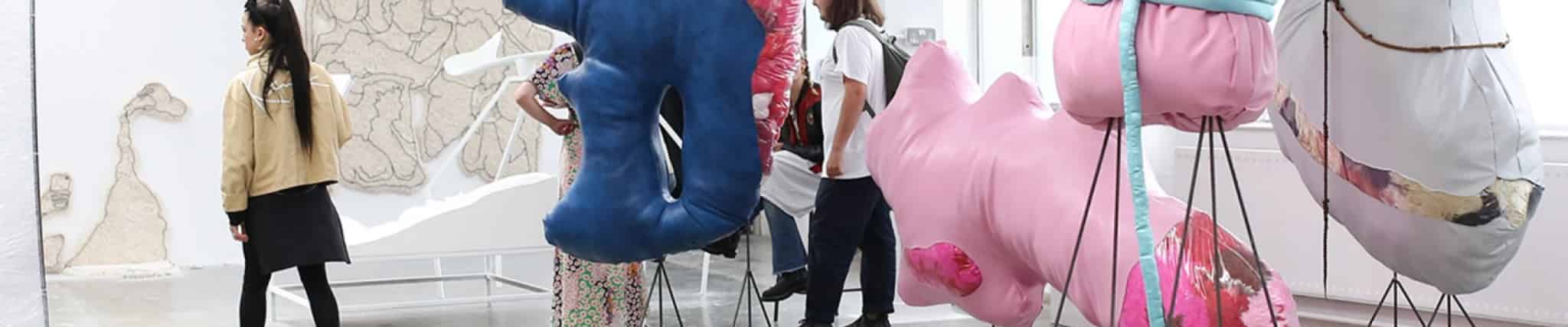
    MA Fine Art at Central Saint Martins supports a broad range of experimental practices. It will test and challenge your practice, bringing it into a contemporary critical context. Our research-based teaching strategies actively seek to extend your experience and skills. We work responsively to your changing needs as individuals. We also encourage collaborative projects in relation to your work.

    The course is home to a wide range of international artists. Our students work in many media including painting, sculpture, print, installation, time-based and digital. The course offers an environment where complex social, cultural and artistic view-points are negotiated. Art-making in this context is a testing ground for ideas and media. Artists who study with us are open to change not just in expanding their practices but in creating new positions. Our focus is on student-centred learning, bringing your work and the way you make and imagine practice to critical scrutiny. You will develop your individual research into confident, sustained practice.

    We place an emphasis on the investigation of materials and processes of fabrication; the intelligence of the work is in the making and the approach to realisation. The MA Fine Art course itself has a track record of innovative teaching. There are opportunitiesto work with students from different disciplines and at differentlevels of qualification and this can happen through the extended, digital, campus as well as focused projects. Recent examples have investigated sound-based practices, archival work, virtual reality, photogrammetry, digital publication and animation. These projects strengthen critical engagement with contemporary technologies of making and dissemination. They also work as forums for cross-course and transdisciplinary exchange and collaboration.

    An intensive programme of study will develop your skills and knowledge of research methods in art-related fields. Your learning will extend across our postgraduate Art programme, offering opportunities to meet your peers and to become familiar with the Colleges research community. On the course, we aim to provide you with a range of opportunities and learning experiences, giving you a broad skill-set to go out into professional life.

    Requirements

    Entry Requirements

    The standard entry requirements for this course are as follows:

    • An honours degree
    • Or an equivalent EU/international qualification.

    AP(E)L – Accreditation of Prior (Experiential) Learning

    Exceptionally applicants who do not meet these course entry requirements may still be considered. The course team will consider each application that demonstrates additional strengths and alternative evidence. This might, for example, be demonstrated by:

    • Related academic or work experience
    • The quality of the personal statement
    • A strong academic or other professional reference

    Or a combination of these factors.

    Each application will be considered on its own merit but cannot guarantee an offer in each case.

    English language requirements

    IELTS level 6.5 or above, with at least 5.5 in reading, writing, listening and speaking (please check our main English language requirements webpage).

    Selection criteria

    We select applicants according to potential and current ability in the following areas: 

    • The quality of your practice 
    • Ability to devise and develop a self-directed programme of study 
    • The ability to develop and contextualise work in written form 
    • The ability to analyse and evaluate in both visual and oral terms 
    • Eagerness to contribute to the learning environment at postgraduate level.

    What we are looking for 

    We are seeking imaginative, resourceful individuals who are committed to exploring art practice.

    English Requirements

    • IELTSMin 6.5

    English Program Requirements

    All students need to show proof of their English language ability to enrol at UAL. Most students from outside the UK need to submit an English language test as proof of their language ability.

    If you need help to reach the required language level, UAL's Language Centre offers a range of English courses and a Presessional course for students with a conditional or unconditional offer. Current students at UAL, progressing to the next level of university study (e.g. from Foundation to BA) can take UAL's Progress Test to achieve the IELTS score required for the next level.

    To find out if you are exempt from English language testing, please read exemptions from language testing at the bottom of this page.

    English language tests

    Your English language requirement is generally expressed as an IELTS score but UAL accepts several other English language tests in addition to IELTS.

    Where we state 'IELTS Academic for UKVI', you must provide a certificate for this test. IELTS Academic (not for UKVI) cannot be used to support a student visa application for these levels of study. The University does not accept IELTS General or IELTS General for UKVI for any level of course.

    Please note that you must achieve the required language scores - overall and all 4 skills (unless the test provider exempts you from sitting a skill on the basis of disability) - from a single sitting of a test examination. We cannot accept a combination of 'best' scores from multiple test results.

    Please note that if you take a Cambridge IGCSE exam, you must provide 2 documents:

    • The Certificate
    • The Certifying Statement for CEFR. You will need to request this and pay the fee.

    Minimum IELTS scores

    Our IELTS requirements vary depending on the course and level of study. The requirement for each course is shown on the individual course pages.

    Jump to minimum scores for:

    • Courses that require IELTS 5.0
    • Courses that require IELTS 5.5
    • Courses that require IELTS 6.0
    • Courses that require IELTS 6.5
    • Courses that require IELTS 7.0
    • Courses that require IELTS 7.5

    Career

    Our Postgraduate Art Programme offers valuable opportunities to build transferable professional knowledge and skills. The exchange of perspectives with others through shared units, reading groups and debates helps establish stimulating and productive networks.

    The focus on proposing and developing a major independent programme of study is supported by a shared professional practice lecture series featuring guest speakers plus opportunities to attend symposia and critique work in progress across subject areas. The Postgraduate Art Programme has wide-ranging links with professional organisations, collections and galleries, and includes opportunities for interaction and networking according to your personal career direction.

    Career possibilities for fine art graduates have expanded in recent years in line with increased opportunities in contemporary arts generally, in London and internationally. Alternative pathways for MA Fine Art graduates include residency programmes, performance festivals, teaching, and practising in the community. There are also opportunities in critical writing, curating and further research degree study.

    Recent MA Fine Art alumni activity demonstrates the breadth of student activity within the subject, with many of our fine art graduates prominent in galleries, competitions and events.

    In 2007 Mark Melvin won the Nationwide Mercury Art Prize, Gemma Pardo was selected for the Bloomberg New Contemporaries, and Ayan Farrah founded Front Room Projects. In 2008 Sachiyo Nishimura was selected for New Contemporaries. In 2009 Maurice Citron was part of the Saatchi New Sensations show with his work being seen on Channel 4, and New Contemporaries showcased work by students Johanna Piesniewski and Hannes Ribarits. In 2010 graduates exhibited widely - shows included Bibi Katholm at 2 Taekker Space, Berlin, and the Vegas Gallery, London, and Filipo Caramazza at Hayles Gallery, London. Students Francesca Simon and Gwen Yip were shortlisted for the John Moores Painting Prize 2010.

    Fee Information

    How to Apply

    All applications will be considered by the course team who will consider key elements when making a decision on your suitability to join the course:

    • Firstly they will look at your qualifications and transcript (or projected results).
    • Secondly, they will review your personal statement, portfolio and study/project proposal.
    • There is no requirement for an academic or professional reference.

    Required information for postgraduate course applications

    Before you apply, please take time to read the guidance below. You will be asked to provide the following items and upload documents when completing the online application form:

    • Personal details (including full name; date of birth; nationality; permanent address and English language level)
    • Current and/or previous education and qualification details
    • Employment history
    • CV
    • Personal statement

    Please note: we will ask you for copies of certain documents (for example, English language qualification/certificate and copies of any previous UK study visas). Read our immigration and visa information to find out if you need a visa to study at UAL.

    You can only apply to the same course once per year. Any duplicate applications will be withdrawn. Read the UAL international application advice for further information on how to apply.

    Extra information required for applications to this course

    • Portfolio.
    • Video task.
    • Study / project proposal.

    Start your application now

    There are 2 ways international students can apply to a postgraduate course:

    • Through one of our official representatives in your country
    • By direct application

    The application form can be saved as you fill it out, so you do not need to complete it all at once. You will also have the chance to review all the information and make any necessary amendments before you submit the application form.

    Deferring your place

    This course accepts requests from offer holders to defer their place for one academic year. Deferral requests are granted on a first-come, first-served basis until all deferral places are filled, or a deadline has been reached, whichever is sooner. Read our Admissions Policy for details, including how to request a deferral and by when.

    External Student Transfer Policy

    If you are currently studying at another institution and have successfully completed 60 credits in the equivalent units/modules on your current PG course and wish to continue your studies at London College of Communication, you can apply to transfer.

    The Admissions Tutor will consider applications on a case by case basis, subject to places being available. You must apply directly to the course via the course webpage as early as possible.

    Further information about the external student transfer policy can be found on the Office for Students Information page.

    CV

    Please provide a CV detailing your education, qualifications and any relevant work or voluntary experience. If English is not your first language it is important that you also include in your CV details of your most recent English language test score.

    Personal statement advice

    You’ll be asked to complete a personal statement describing why you want to study on MA Photography. 

    Your personal statement should describe what you specialised in during your undergraduate course , why you now want to study on MA Photography at LCC, and what you are hoping to do after the course.

    The majority of our students have studied either BA Photography or other lens-based/fine-art subjects before applying to our course.

    If you didn’t previously undertake a BA Photography course, please explain why you feel that you meet the academic criteria needed for further study in this subject area.

    Project proposal advice (250 words maximum)

    Your Project Proposal should be a feasible, researched outline of the intended project you plan to photograph during your time on the course.

    This should include how you plan to develop your project, and also provide a sense of subject matter, visual style, conceptual approach and associated research, as well as your existing knowledge of contemporary fine art photography.

    MA Fine Art

    University of the Arts London (UAL)

    University of the Arts London (UAL)

    United Kingdom

    United Kingdom, London