

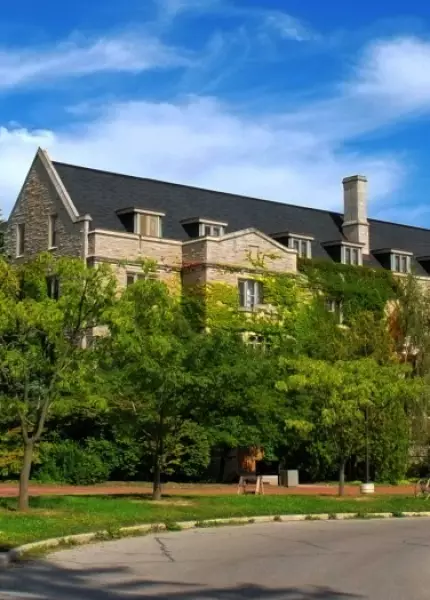


The Master of Landscape Architecture (MLA) is offered by the School of Environmental Design and Rural Development (SEDRD) to prepare students for creative thinking and collaborative learning leading to professional careers. It is an intensive, internationally-recognized design program that offers diverse opportunities for study, research, creative design, and professional practice.
Landscape architects play an important role in shaping our environment, working collaboratively with other designers, scientists and the public. As a landscape architect you will be involved in analyzing, designing, constructing, conserving, and managing landscapes from small-scale sites to entire communities.
Immersive design learning
Explore the profession through peer-to-peer sharing, field study, in-depth discussions, seminars, lectures, and landscape design studios with real clients.
National accreditation
The MLA program is accredited by the Canadian Society of Landscape Architects, recognized by the American Society of Landscape Architects, and meets international requirements to facilitate membership in professional associations.
Learn from the best
Study with internationally-recognized faculty, and practicing professionals who have diverse experiences and perspectives. They hold degrees in landscape architecture, and related fields, and have practiced in a variety of settings.
Publish research
Make a significant contribution to landscape architecture by publishing with faculty members in top international journals, as well as professional/industry periodicals.
Excellent facilities
Access dedicated and comfortable studios and classrooms, as well as computing output facilities.
Secure your career
Graduate with a degree that's in demand by employers all over the world due to its focus on both theory and practice, and students' experience in practical and community projects.
This program is delivered in-person in a full-time format at the University of Guelph campus.
Sample Courses
- Landscape Architecture Studio (I, II, III, IV)
- Community Design
- Landscape History
- Professional Practice Seminar
- Environmental Design
- Research Methods
This is just a sample of the course options. View all MLA courses here.
Program Curriculum and Requirements
The MLA degree program is structured for students to acquire and master a professional level of design competency. The curriculum has three integrated streams: design theory and practice, landscape analysis and planning, and research inquiry and application. The MLA program leads to a professional degree that meets the educational requirements for entry into professional associations across Canada, North America and abroad.
In the first two years of the MLA program, learning is centered around design studios that apply theoretical knowledge to practical projects ranging in scale from individual sites to entire communities and regions. Field studies and labs, peer-to-peer sharing, construction studios, lectures, online courses, and seminars advance students’ knowledge and capacity and develop professional skills. Students can elect to participate in international exchange programs with partner schools to further develop their areas of interest and expand their professional networks.
The final year of the MLA program is focused on the individual interests of each student and on completion of a master’s thesis. For most of our MLA students, their thesis is the first step toward a specialized area of professional practice or to doctoral studies.
This program is designed for individuals with an honours degree other than the Bachelor of Landscape Architecture. The prescribed studies consist of at least thirteen graduate courses (6.25 credits) and a thesis requiring six semesters of full-time study over three calendar years. Students normally register for Fall and Winter semesters each year, and take a scheduled break during the Spring/Summer semester to gain practical experience.
Applicants who have several years of substantial professional experience subsequent to their first professional degree will be required to undertake a program of at least five graduate courses (2.25 credits) and a thesis.
Please refer to the Landscape Architecture Graduate Calendar for program overview, requirements and courses.
Career opportunities for University of Guelph’s MLA graduates are enhanced by the program's national and international reputation based on thirty years of experience preparing students for careers in landscape architecture and related fields. Graduates enjoy a broad range of career opportunities in:
- Private-sector landscape architecture practices
- Design-build firms
- National, provincial, regional and municipal agencies where they provide expertise within parks and recreation, community development, transportation, engineering and planning departments
- Specialization, such as landscape restoration, resort design, community design , heritage conservation or computer visualization
- Academic careers
This program is predominantly a self-funded professional program. As such, students need to be prepared to cover the full costs of the program.
Here are a few funding supports that are available to MLA students:
- Entrance Scholarships: Each year the MLA program strives to provide entrance scholarships to students with strong academic performance. The value and quantity of this financial support changes from year to year.
- Graduate Teaching Assistantships: The School of Environmental Design and Rural Development hires a number of MLA graduate students (GTA's) to provide support to our undergraduate courses. These positions are advertised by application in advance of each fall and winter semester.
- University Scholarships: The University of Guelph offers resources to financially support graduate students. Please refer to the University of Guelph scholarships and awards and information available from Student Financial Services.
- Ontario Graduate Scholarship (OGS) Program: Applicants who qualify for the Ontario Graduate Scholarship (OGS) program require a complete OGS application and a complete graduate application to be submitted by the deadline date set each year (typically by January 31st).
More details on funding your graduate studies are available on the Graduate & Postdoctoral Studies website.