
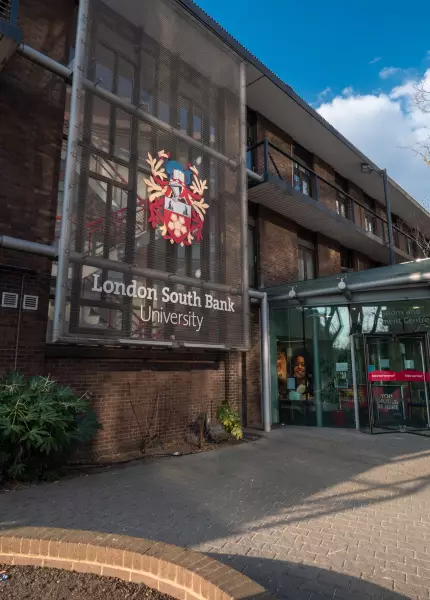
BSc (Hons) CRIMINOLOGY

    BSc (Hons) CRIMINOLOGY

    Duration3 year(s)
    Tuition Fee
    GBP 20,844 / year(s)
    Next IntakeSeptember 24, 2026
    BSc (Hons) CRIMINOLOGY

    About

    What factors can explain changes in crime rates? How is climate change linked to the crimes of the powerful? Are prisons the appropriate response to criminal acts? Are we all treated equally before the law?

    These are some of the issues you will explore in this course, by looking at the complex interactions between the state, the offender, the victim and society. You will think critically about how laws are made and how social structures shape both crime and responses to crime.

    Why Criminology at LSBU?

    check-circle
    On this course, 87.1% of students think that teaching staff are good at explaining things (National Student Survey 2025).
    puzzle-piece
    We have an employability guarantee. We offer opportunities for all undergraduate students in Year 1 to build employability skills which leads to Year 2 opportunities to apply for placements in our ‘Working In’ Module.
    mortar-board
    We have strong professional links. Our Criminology courses open pathways to careers in a variety of settings including probation, policing, the prison service, NGOs, local authorities, the voluntary sector, youth offending teams, teaching, social work and administration.
    users
    Experienced research informed teaching by experts - you'll learn from expert professionals who know what it takes to succeed in the field. Our research-active academics whose work is nationally and internationally recognised, and informs your learning. Our critical approaches routed in the community and lived experiences. Our critical approaches are rooted in the community, lived experiences and underpinned by a commitment to social justice.
    power-off
    Examples of expertise include Crime Location Place and Space; Contemporary Criminology; Gender and Youth Justice; Policing; Prisons; and Crimes of the powerful.
    book
    You’ll have access to our Oxford University Press Trove online library of high quality textbooks. We also have an award-winning library for group and quiet study space.
    link
    Link with the LSBU Justice, Conflict, Activism and Communities Research Group, which organises a series of research seminars and public events throughout the year where you can meet with researchers, practitioners and campaigners.

    Requirements

    Entry Requirements

    Entry Level Requirements

    Need further information? Call us on 0800 923 8888 to discuss entry requirements.

    112 UCAS points

    Or equivalent level 3 qualifications.

    If you do not meet the entry criteria above we also review any previous skills, knowledge or experience you have gained outside of your education and are happy to talk through any extenuating circumstances you feel relevant.

    Visit UCAS for guidance on the tariff.

    Career

    Careers

    Employability Service

    At LSBU, we want to set you up for a successful career. During your studies – and for two years after you graduate – you’ll have access to our Employability Service, which includes:

    • An online board where you can see a wide range of placements: part-time, full-time or voluntary. You can also drop in to see our Job Shop advisers, who are always available to help you take the next step in your search.
    • Our Careers Gym offering group workshops on CVs, interview techniques and finding work experience, as well as regular presentations from employers across a range of sectors.

    Our Student Enterprise team can also help you start your own business and develop valuable entrepreneurial skills.

    Career opportunities

    Our students volunteer and find jobs in a range of setting, including the police service, the prison service, legal advice, victim support, domestic violence and child abuse agencies and charities, youth offending and youth mentoring schemes.

    A social science degree also has the real advantage of opening up careers in a number of professions such as teaching, social work, administration and higher level education. Other graduates have forged exciting careers in research, public relations, advertising, retail, management and media-related work.

    Career roles

    One popular role is as a probation officer working with offenders before, during and after they are sentenced. Possessing a great deal of patience, strong oral communication skills and a non-judgemental attitude, working in probation can be very rewarding work. A qualified probation officer can earn between £28,000-£35,000. (National Careers Service)

    The police service also offers a wide variety of long-term opportunities providing a two-year probationary period is completed. Salaries after 5 years can be up to £30,000. (BBC News)

    There are a number of career opportunities within the criminal justice system or agencies and charities working with victims of crime, ex-offenders, and witnesses.

    Career progression

    The academic strength of our programmes has allowed many graduates to continue onto postgraduate degrees and academic research.

    Criminology staff have links with practitioners working in the criminal justice system and utilise the expertise of these contacts to organise guest speakers so students are able to hear from industry experts.

    For example:  Harry Potter, a criminal defence barrister, and a former fellow of Selwyn College Cambridge, says his famous name has been a distinct advantage. He has represented clients in all areas of crime, including court-martials. He is a published author of several books on legal and Scottish history and  his latest book on the history of prisons will shortly be published. He has worked for the BBC presenting a TV series on our legal system and a documentary on capital punishment. He is also a qualified Church of England priest and for eight years was a prison chaplain attending many lifer review hearings. He believes that too many people are jailed and for too long. He regularly lectures at LSBU on the death penalty, criminal justice and prisons.

    Optional Work Placement

    Students will complete a work-based learning module as part of their second year where they will complete an optional work placement or take part in other forms of work-based learning. In the past, our students have volunteered with charities and criminal justice agencies, with local authorities, on programmes ranging from rehabilitation of offenders to victim support and campaigner groups. Through these, students contribute to real world situations linked to their subject of interest. In many cases, students maintain a relationship with the organisation they volunteer for. Placements ground a student's experience, provide confidence and bolster a CV immeasurably.

    Our students have taken up work placements at:

    • Chance UK – a unique early intervention mentoring organisation who provide adult volunteer mentors to work with children aged 5-11 years at risk of developing anti-social behaviour in later life.
    • Kairos in Soho – a pan-London LGBT Community Development Organisation.
    • The Naz project London – a sexual health organisation that works to mobilise Black and Minority Ethnic (BME) communities in relation to HIV and other sexual health concerns.
    • Richmond Advice and Information on Disability (RAID)
    • Women's Royal Voluntary Service (WRVS)

    Fee Information

    Tuition Fee
    20,844 / year(s)
    BSc (Hons) CRIMINOLOGY
    London South Bank University
    London South Bank University
    United Kingdom

    United Kingdom, London

    Go to Official Website
    WhatsApp student consultation with YouApply