

Biology is the study of all living things–including microscopic bacteria and viruses, plants, and animals, and their relationship to their environments. Biology majors study the structure and function of cells, organ systems and tissues of animals and plants, ecology (the relationship between living things and their environment), animal behavior, genetics/genomics and evolution. They learn about physiology, behavior, genetics and heredity, aquatic systems, microscopic organisms such as bacteria, and techniques for diverse areas ranging from field research to biotechnology. This major provides a solid foundation of understanding the basic biological sciences. It also offers an opportunity to choose an area of emphasis within life sciences that relates to particular career goals (for example: the ecology of organisms, cell and molecular biology, biomedical professions, aquatic biology, marine biology, plant molecular biology for agricultural biotechnology and bioenergy, evolutionary biology, etc.).
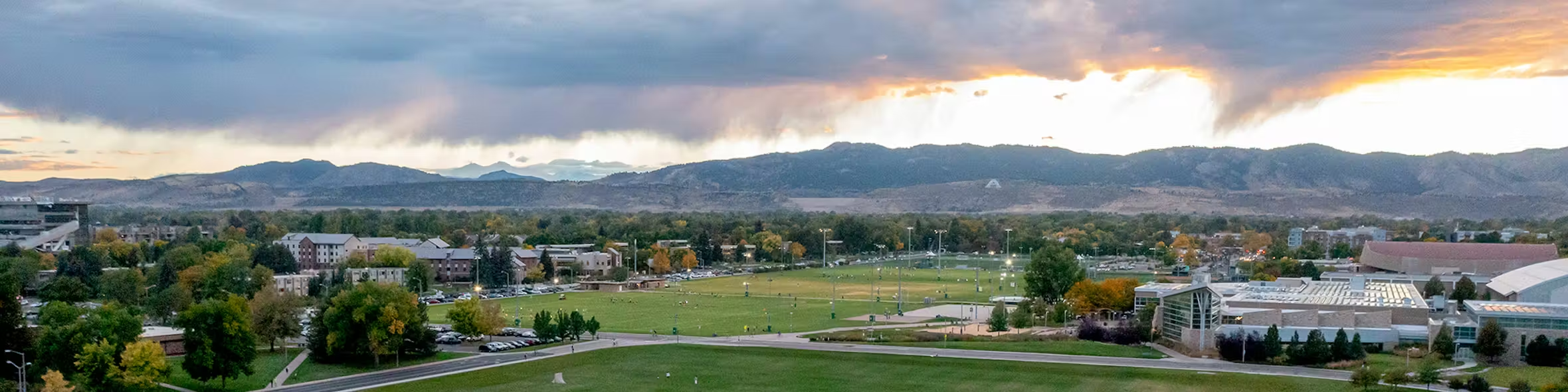
Bachelor of Biological Science at Colorado State University

The Biological Science at Colorado State University is a Full Time Bachelor program offered at the university's main campus in Fort Collins , United States of America. The program is delivered on campus in English and can be completed in 4 years. Students develop academic knowledge and practical skills that prepare them for future careers in this field. The next available intake starts on August 21, 2027.
About Bachelor of Biological Science
In addition to mastery of biological knowledge and skills, students will:
- Interpret scientific data both mathematically and statistically.
- Demonstrate organizational and laboratory skills.
- Define scientific hypotheses and design experiments or observations to test them.
- Work effectively in groups.
- Demonstrate strong writing and oral communication skills.
Disciplines
Requirements and Admission Criteria for Bachelor of Biological Science at Colorado State University
Entry Requirements
Personal Statement
What we call a “personal statement” is called the “personal essay” in the Common Application. This short writing piece is your opportunity to help us understand what makes you unique, to share a talent or element of your identity that’s important to you, to describe what you are passionate about, or to highlight an accomplishment you’re proud of.
Transcripts
- Submit your most recent transcripts or mark sheets. We will ask for additional materials if necessary.
- All decisions are provisional until a final, official transcript verifying graduation is received.
- Only transcripts sent directly from the school or stamped and sealed are considered official.
- If a record is not in English, a certified literal English translation must accompany the transcript.
If you need a student visa, you must submit the following items in order to secure an I-20 or DS-2019:
- Immigration Information Form
- Copy of the identification page of your passport which must be valid for at least six months beyond the first day of classes.
- Financial support documents demonstrating the ability to meet or exceed your estimated expenses. Because none of our institutional scholarships cover the full cost of attendance, you must be able to show outside funding.
Immigration information is not considered in the admission decision.
English Requirements
- IELTSMin 6
- TOEFLMin 72
Career Opportunities after Completing Bachelor of Biological Science
Training in biology prepares students for a wide variety of occupations. Some involve daily interaction within teams; others can be done in relative isolation; some are highly focused, but most require knowledge far beyond the sciences. A degree in biological science offers a broad foundation for professional degrees in nursing, dental, medical or veterinary school, and a number of health professions such as physician's assistant, physical therapy, occupational therapy, optometry or public health. Graduates often pursue advanced degrees in life sciences to carry out basic research or advance into leadership positions in industry. Participation in internships and/or laboratory research experience is highly recommended and strongly encouraged by the department to enhance practical training and development.
Our biology graduates have gone on to careers as: aquarium, zoo, and museum worker; assistant research scientist; research technician in industry or university laboratories; biology photographer; biotechnologist; brewery laboratory assistant; consumer product researcher; marine bacteriologist, field ecologist; nuclear medicine technician; park naturalist; pharmaceutical researcher or salesperson; public health officer; science librarian; environmental educator, health specialist, or impact specialist; fisheries biologist or conservationist; industrial hygienist; occupational therapist (with a master's degree); and medical or clinical laboratory technologist.
Combining biology with additional skills can lead to other exciting transdisciplinary careers. Biology and computer science can be linked to the ever-expanding and exciting area of bioinformatics. Biology and writing can be incorporated into a career as a technical writer or science fiction novelist. Biology and visual arts combine in medical and scientific illustration. Biology and other humanities may lead to studies of the history of science or medicine. Work in both biology and philosophy/religion can be incorporated in careers in bioethics. Biology is linked with psychology for the neuroscientist or genetic counselor. Study biology and political science to work in environmental law or be a patent lawyer in biotechnology. Try mixing biology and business to get into hospital administration, small business or biotechnology administration. Specialized master's degrees are designed for many of these unique career paths.
Tuition and Fee Information for Bachelor of Biological Science at Colorado State University
How to Apply for Bachelor of Biological Science at Colorado State University
Application Materials
All applicants for admission must submit an online application, $50 application fee or fee waiver request, and academic transcripts. Freshman/first-year applicants are required to submit a personal statement. The application includes an optional Academic Explanation section for applicants to provide more context for their performance and/or enrollment history. Recommendations and ACT/SAT scores are not required. The Office of Admissions may request additional information before completing a full review of an applicant’s application file.
Refer to the appropriate application guides for details.
Application Fee or Fee Waiver
An application fee is required as part of a complete application; a decision cannot be rendered without it. If payment of the application fee presents a financial hardship, applicants can request a fee waiver.
Refer to the Office of Admissions website for the application fee refund policy.
High School Transcript and proof of graduation (or equivalent)
High school performance, as reflected on a student's transcript(s), is an essential component of the admission decision for all freshman/first-year applicants and for transfer applicants with fewer than 30 post-high school credits.
High school transcripts for transfer applicants with more than 30 post-high school credits are considered only when needed to satisfy the admission requirement in mathematics.
All freshman/first year applicants and all transfers with fewer than 60 post-high school college credits must submit proof of high school graduation or equivalent prior to the start of their first semester of enrollment.
ACT/SAT results
ACT or SAT test scores are not required. Our review process is individualized, includes a range of academic and personal factors and emphasizes students’ efforts and achievement demonstrated over 3-4 years. Test scores are not given much weight in the admission decision and are not considered at all for scholarships. Students who wish to have their scores considered in the admission decision should email [email protected] with this request.
ACT or SAT results can be used for composition placement purposes and thus can be helpful to submit by any incoming student before orientation/registration.
College Transcript(s)
Freshman/first-year applicants typically are required to submit an official college transcript at the point of application only if college enrollment is being used as their full-time high school curriculum (such as early college, ASCENT and fifth-year programs, and some homeschool curricula). Refer to College-Level Courses Completed by High School Students for additional information.
Transfer applicants must submit an official college transcript from each college attended, regardless of the type of institution, amount or type of credit earned, and age of the credential, even if the work will be reflected in transfer on another transcript. No part of the previous collegiate record may be disregarded. Failure to include all institutions previously attended may result in the rescinding of admission, loss of credit, or disenrollment. Transcripts reflecting courses taken at vocational-technical institutes or colleges that are not regionally accredited can be helpful documentation and may be required, though they do not qualify an applicant for transfer applicant status or advanced-standing credit.
Second Bachelor applicants are only required to submit an official transcript from the college/university from which they earned their first (or most recent) bachelor's degree. Official transcripts from other colleges/universities attended (if applicable) are encouraged if an applicant is seeking a competitive major or to demonstrate explicit pre-requisites for their new degree program.
Advanced standing credit (transfer credit) is only awarded from an official transcript.
International Applicants: Additional Requirements
In addition to the documents outlined above, applicants who have completed part or all of their education outside of the US also may be prompted to submit the following:
- A certified English translation of any academic credentials not in English
- Evidence of English Proficiency to be considered for direct admission
- An Immigration Information Form, financial support documentation and a copy of the passport identification page for immigration documentation
Application Timelines
Students can begin their enrollment during fall semester (August start), spring semester (January start) or summer term (May/June start; not recommended for freshman/first-year students).
Applicants are encouraged to apply 6-12 months prior to the start of the term. Freshman/first-year applicants must have completed at least 75% of their high school curriculum (through junior year equivalent) before a decision can be rendered; transfer applicants must have no more than one academic term in progress when a decision is rendered. Second bachelor’s/post-bachelor candidates must be finished with their first degree or in their final term of enrollment with degree pending for a decision to be rendered.
Refer to the appropriate application guides for more detail about application dates and timelines.

United States of America, Fort Collins