

Human Development and Family Studies (HDFS) is an interdisciplinary major focusing on the health and development of individuals across the lifespan, within the context of diverse families and social identities. Students complete foundational coursework in human development (i.e., infancy and childhood, adolescence, emerging and young adulthood, middle and later adulthood/aging), family studies, and evidence-based prevention and intervention programming in human services. Students study theory and emerging research in the field and learn to identify risk and protective factors influencing cognitive, emotional, social, and physical development across the lifespan. During their final year, HDFS students apply knowledge and skills from foundational course work through participation in a semester-long internship. Internship is a hallmark of the degree program that serves as a culminating experience preparing students for a professional career with diverse populations, communities, and organizations. The HDFS major offers five concentrations that enable students to specialize within their degree and prepare for a variety of career paths in human services. In addition to selecting one of five concentrations, students have the opportunity to earn the Gerontology Interdisciplinary Minor, work toward Director Qualifications in early childhood settings, or apply to the Major in Early Childhood Education. The HDFS department is committed to promoting the success and well-being of students from heterogeneous backgrounds and experiences.
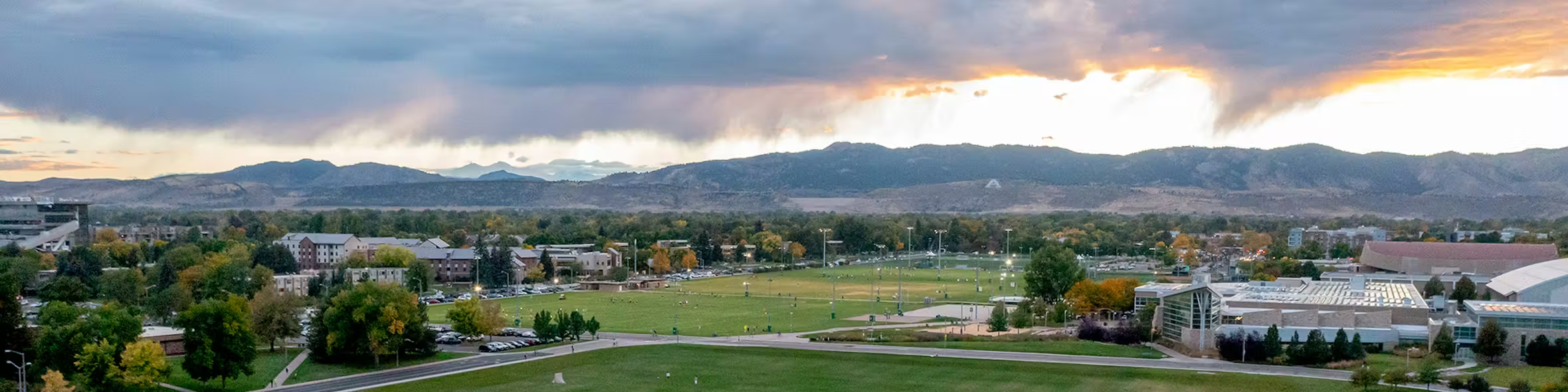
Bachelor of Human Development and Family Studies at Colorado State University

Colorado State University offers the Bachelor of Human Development and Family Studies as a full-time degree delivered on campus at its Main Campus and Online campuses in Fort Collins , United States of America. Taught in English and completed over 4 years, the program equips students with the theoretical knowledge and practical skills required for human development and family studies and related professional fields. The next available intake begins on August 21, 2027.
About Bachelor of Human Development and Family Studies
Students will demonstrate:
- Content knowledge and understanding of theory, research, and practice relevant to optimizing the development, health, and well-being of individuals and families across the lifespan in the context of the larger social environment.
- Effective written and oral communication skills appropriate to the field of human development and family studies.
- The ability to access, critically evaluate, and apply multiple forms of information related to individuals and families.
- Professional and leadership skills with individuals and families, including ethical and culturally sensitive conduct.
Disciplines
Requirements and Admission Criteria for Bachelor of Human Development and Family Studies at Colorado State University
Entry Requirements
Personal Statement
What we call a “personal statement” is called the “personal essay” in the Common Application. This short writing piece is your opportunity to help us understand what makes you unique, to share a talent or element of your identity that’s important to you, to describe what you are passionate about, or to highlight an accomplishment you’re proud of.
Transcripts
- Submit your most recent transcripts or mark sheets. We will ask for additional materials if necessary.
- All decisions are provisional until a final, official transcript verifying graduation is received.
- Only transcripts sent directly from the school or stamped and sealed are considered official.
- If a record is not in English, a certified literal English translation must accompany the transcript.
If you need a student visa, you must submit the following items in order to secure an I-20 or DS-2019:
- Immigration Information Form
- Copy of the identification page of your passport which must be valid for at least six months beyond the first day of classes.
- Financial support documents demonstrating the ability to meet or exceed your estimated expenses. Because none of our institutional scholarships cover the full cost of attendance, you must be able to show outside funding.
Immigration information is not considered in the admission decision.
English Requirements
- IELTSMin 6
- TOEFLMin 72
Career Opportunities after Completing Bachelor of Human Development and Family Studies
Graduates with a major in HDFS are prepared to work in a range of human service sector settings including youth services organizations; early childhood, elementary, adolescent, and parent education programs; health-care settings; juvenile and adult corrections and criminal justice; family and community services; and programs serving older adults, including long-term care facilities. HDFS graduates are also well prepared to pursue graduate studies in mental health, behavioral and social sciences, education, health and medicine, policy and public health, and other professional programs. Students interested in teaching human development and family studies content at the secondary level should explore the interdepartmental Major in Family and Consumer Sciences, Family and Consumer Sciences Education Concentration.
Some examples of career opportunities students may pursue with a bachelor's degree in HDFS include, but are not limited to: early childhood administrator and teacher, adult recreation programmer, administrator in adult and aging facilities, career development specialist, family services specialist, human development specialist, adult education teacher, human resources coordinator, youth agency administrator, community outreach worker, women's program administrator, youth intervention and prevention program administrator, youth employment, training, and development specialist, parent educator, children-family educator, child protection worker, family assistance worker, program administrator, public relations specialist, student affairs professional, youth services worker, case manager, nonprofit agency administrator, and residential center manager.
To help guide students in career planning, there are five concentrations within the Major in Human Development and Family Studies. The HDFS program of study consists of the HDFS foundational courses, which are required for all students regardless of concentration, 15 credits selected from the list of courses within students' chosen concentration, and additional electives to reach the minimum of 120 credits required for graduation. Students must declare at least one concentration and may declare up to two concentrations in the HDFS major. The declared concentration(s) are listed on the students' transcripts and thus indicate specialized training within the HDFS degree program.
Tuition and Fee Information for Bachelor of Human Development and Family Studies at Colorado State University
How to Apply for Bachelor of Human Development and Family Studies at Colorado State University
Application Materials
All applicants for admission must submit an online application, $50 application fee or fee waiver request, and academic transcripts. Freshman/first-year applicants are required to submit a personal statement. The application includes an optional Academic Explanation section for applicants to provide more context for their performance and/or enrollment history. Recommendations and ACT/SAT scores are not required. The Office of Admissions may request additional information before completing a full review of an applicant’s application file.
Refer to the appropriate application guides for details.
Application Fee or Fee Waiver
An application fee is required as part of a complete application; a decision cannot be rendered without it. If payment of the application fee presents a financial hardship, applicants can request a fee waiver.
Refer to the Office of Admissions website for the application fee refund policy.
High School Transcript and proof of graduation (or equivalent)
High school performance, as reflected on a student's transcript(s), is an essential component of the admission decision for all freshman/first-year applicants and for transfer applicants with fewer than 30 post-high school credits.
High school transcripts for transfer applicants with more than 30 post-high school credits are considered only when needed to satisfy the admission requirement in mathematics.
All freshman/first year applicants and all transfers with fewer than 60 post-high school college credits must submit proof of high school graduation or equivalent prior to the start of their first semester of enrollment.
ACT/SAT results
ACT or SAT test scores are not required. Our review process is individualized, includes a range of academic and personal factors and emphasizes students’ efforts and achievement demonstrated over 3-4 years. Test scores are not given much weight in the admission decision and are not considered at all for scholarships. Students who wish to have their scores considered in the admission decision should email [email protected] with this request.
ACT or SAT results can be used for composition placement purposes and thus can be helpful to submit by any incoming student before orientation/registration.
College Transcript(s)
Freshman/first-year applicants typically are required to submit an official college transcript at the point of application only if college enrollment is being used as their full-time high school curriculum (such as early college, ASCENT and fifth-year programs, and some homeschool curricula). Refer to College-Level Courses Completed by High School Students for additional information.
Transfer applicants must submit an official college transcript from each college attended, regardless of the type of institution, amount or type of credit earned, and age of the credential, even if the work will be reflected in transfer on another transcript. No part of the previous collegiate record may be disregarded. Failure to include all institutions previously attended may result in the rescinding of admission, loss of credit, or disenrollment. Transcripts reflecting courses taken at vocational-technical institutes or colleges that are not regionally accredited can be helpful documentation and may be required, though they do not qualify an applicant for transfer applicant status or advanced-standing credit.
Second Bachelor applicants are only required to submit an official transcript from the college/university from which they earned their first (or most recent) bachelor's degree. Official transcripts from other colleges/universities attended (if applicable) are encouraged if an applicant is seeking a competitive major or to demonstrate explicit pre-requisites for their new degree program.
Advanced standing credit (transfer credit) is only awarded from an official transcript.
International Applicants: Additional Requirements
In addition to the documents outlined above, applicants who have completed part or all of their education outside of the US also may be prompted to submit the following:
- A certified English translation of any academic credentials not in English
- Evidence of English Proficiency to be considered for direct admission
- An Immigration Information Form, financial support documentation and a copy of the passport identification page for immigration documentation
Application Timelines
Students can begin their enrollment during fall semester (August start), spring semester (January start) or summer term (May/June start; not recommended for freshman/first-year students).
Applicants are encouraged to apply 6-12 months prior to the start of the term. Freshman/first-year applicants must have completed at least 75% of their high school curriculum (through junior year equivalent) before a decision can be rendered; transfer applicants must have no more than one academic term in progress when a decision is rendered. Second bachelor’s/post-bachelor candidates must be finished with their first degree or in their final term of enrollment with degree pending for a decision to be rendered.
Refer to the appropriate application guides for more detail about application dates and timelines.

United States of America, Fort Collins