
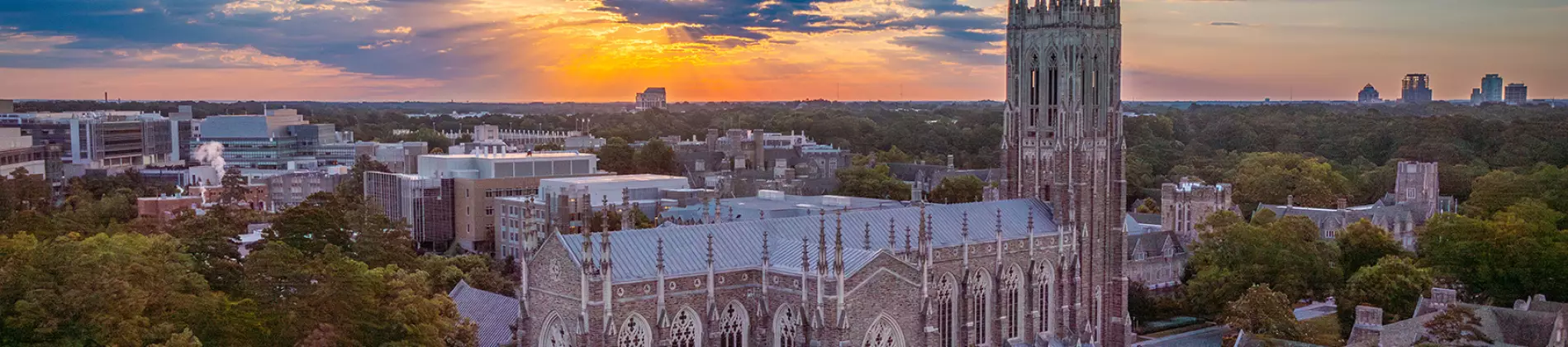
PhD in Environmental Policy at Duke University

    PhD in Environmental Policy at Duke University

    PhD in Environmental Policy at Duke University

    The Environmental Policy at Duke University is a PhD program designed for students who want to build the knowledge and skills required for careers in this field. Delivered on campus at the university's main campus in Durham , United States of America, the program is taught in English and takes 5 years to complete. Students study in a Full Time environment while preparing for future professional opportunities. The next intake starts on January 10, 2027.

    About PhD in Environmental Policy

    The University Program in Environmental Policy (UPEP) is a multidisciplinary, research-focused five-year doctoral degree, intended to prepare candidates for positions in applied academic departments and professional schools (e.g., environment and natural resources, public policy, public administration, international affairs), domestic and international public agencies and environmental organizations, research institutes, and policy consulting firms. Although the program is multidisciplinary, it is designed to ensure that students have strength in a particular social science discipline. Students designate their concentration when applying and currently may select either environmental economics or environmental politics. Students interested in doctoral studies at Duke can also study the environment from a social science perspective through the disciplinary PhD program in Economics and PhD program in Political Science, and the interdisciplinary PhD program in Marine Science and Conservation. Students interested in an applied social science degree without a specific focus on the environment should apply to the PhD program in Public Policy Studies. Students interested in natural science aspects of the environment should consider the PhD program in Environment, PhD program in Earth and Ocean Sciences, PhD program in Marine Science and Conservation, and PhD program in Ecology. UPEP is the first and only PhD program in the United States jointly administered by a school of the environment and a school of public policy. It provides a focal point for faculty and graduate students in the Nicholas School of the Environment and the Sanford School of Public Policy who are interested in environmental policy. It draws on the intellectual resources of not only the two schools but also related disciplinary departments (Economics, Political Science) and other professional schools (Law School, Fuqua School, Pratt School of Engineering) at Duke. Faculty in the program conduct research on economic and political aspects of a wide range of topics, including air and water quality, biodiversity conservation, climate change, community resources management, corporate sustainability, ecosystem services, energy, environmental health, fisheries, forests, freshwater, and marine resources, in both U.S. and international contexts. Applicants are encouraged to contact faculty members with related interests to learn more about their current research projects and interest in accepting new doctoral students. Students in the program: Successfully complete a minimum of 40 course credits (approximately 13 three-credit courses), which include: A set of common requirements, including courses in the political-economic theory of public policy (PUBPOL 901/902, 6 credits), a series of research workshops leading to the dissertation proposal (ENV 834S, 4.5 credits), and at least one course in environmental/resource economics (3+ credits). Disciplinary concentration requirements, including core theory (6+ credits) and research methods (6+ credits) in economics or political science, and corresponding environmental field courses (i.e., environmental economics or environmental politics; (6 credits). As needed, appropriate training in natural sciences relevant to the student's research. The level and content of such training is flexible and is worked out in consultation with the student's advisor and committee. Regularly attend and participate in one or more research seminars in which faculty and others present their research. Attain dissertation status, including meeting qualifying requirements and passing the preliminary exam, by the end of the third year. Pass a final examination, which consists of an oral dissertation defense to an approved supervisory committee. This is typically completed by the end of the fifth year. A successful Environmental Policy PhD dissertation must constitute a significant contribution to policy-relevant knowledge, either through innovative application of social science methods to environmental policy problems, or by innovation in theory or methods appropriate for addressing environmental policy problems. Students normally receive a stipend and a scholarship to cover tuition and fees for up to five years of study if they maintain satisfactory progress toward their degree. Support during the first 2-3 years is usually in return for service as a teaching assistant, with support during the remainder of the program expected to come from research grants managed by a student's major professor. Some students also compete successfully for fellowships offered by the Graduate School and other sources at Duke. Applicants are encouraged to explore external sources of fellowship support (e.g., National Science Foundation) during the application process. Students in the program can interact with researchers at several centers and institutes at Duke University including the Nicholas Institute for Environmental Policy Solutions, the Center on Global Change, the Duke Global Health Institute, the Social Science Research Institute, the Duke Center for International Development, and the Triangle Census Research Data Center. They can also interact with visiting researchers through two research seminar series supported by UPEP--the Environmental Institutions Seminar Series held at Duke and the regional Triangle Resource and Environmental Economics Seminar Series organized by Duke, North Carolina State University, UNC Chapel Hill, and Research Triangle Institute, along with numerous other seminar series in the Nicholas School, the Sanford School, the Departments of Economics and Political Science, and other Duke schools, departments, institutes, and centers.

    Requirements and Admission Criteria for PhD in Environmental Policy at Duke University

    Entry Requirements

    • Transcripts: Unofficial transcripts required with application submission; official transcripts required upon admission
    • Letters of Recommendation: 3 Required
    • Statement of Purpose: Required
    • Résumé: Required
    • GRE Scores: GRE General (Optional for 2022)
    • English Language Exam: TOEFL, IELTS, or Duolingo English Test required* for applicants whose first language is not English
      *test waiver may apply for some applicants
    • GPA: Undergraduate GPA calculated on 4.0 scale required

    English Requirements

    • IELTSMin 7
    • TOEFLMin 90

    English Program Requirements

    If your first language is not English, you must submit scores from the Test of English as a Foreign Language (TOEFL), the International English Language Testing System (IELTS) test, or the Duolingo English Test.

    Tuition and Fee Information for PhD in Environmental Policy at Duke University

    Application Fee 95
    PhD in Environmental Policy at Duke University
    Duke University
    Duke University
    United States of America

    United States of America, Durham

    WhatsApp student consultation with YouApply