

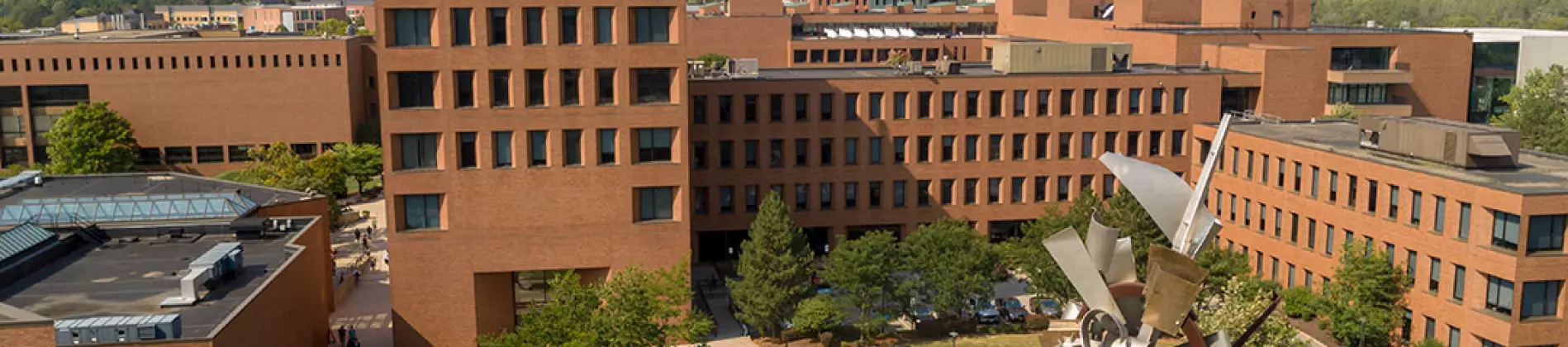


- RIT's new Global Cybersecurity Institute is one of the world's leading cybersecurity education and research centers. This 52,000-square-foot, state-of-the-art facility was designed for a holistic, multidisciplinary approach to cybersecurity.
- RIT's Cyber Range and Training Center is capable of hosting more than 5,000 virtual machines simultaneously in immersive scenarios that simulate countless cyber scenarios ranging from industrial to governmental and military.
- RIT students are recognized as powerhouse competitors in both offensive and defensive cybersecurity competitions. We won the 2021 Collegiate Penetration Testing Competition Global Finals and the 2013 Collegiate Cyber Defense Competition National Championship.
- RIT is recognized as a National Center of Academic Excellence in Cyber Defense Research and a National Center of Academic Excellence in Cyber Defense Education by the Department of Homeland Security and the National Security Agency.
The scope and demand of computer systems and networks, and the span of these systems, increases in organizations every day. At the same time, dependence on computer systems security and computing security technologies is growing dramatically, as is the creation of malicious software that attacks computing systems and networks. Computer systems security is now a major concern for organizations large and small to ensure information stays secure for the privacy of client/customer information, efficient business success, and smooth continuity in operations. As a result, there is an urgent demand for highly trained computing security professionals who can secure and protect an organization's digital assets from relentless attack. In addition, there is a critical need for the continued development of advanced computer security technologies, including hardware and software infrastructures, to both house valuable digital assets and ensure their protection.
RIT's Cybersecurity Bachelor's Degree
RIT's computing security BS program is a cybersecurity degree that produces professionals who understand the people and processes that impact computer systems security. In addition to acquiring state-of-the-art knowledge in protecting digital assets of large or small organizations, you will learn to proactively identify security vulnerabilities in software, hardware, and infrastructure, and provide and implement actionable solutions that protect the assets of an organization. You will learn to collect digital forensic evidence to reveal network and data breach incidents, attribute the attackers or origin of attack, assess the extent of the damage or loss of information, and design strategies that ensure information is protected from future attacks.
Computing Security Courses
In the first two years of the program, RIT's cybersecurity degree provides you with a solid foundation in computer science and mathematics. Core courses include a programming sequence, an ethics course, a computer networking and system administration sequence, and foundation courses in computer and network security.
Starting in the third year, you will begin an in-depth exploration of a range of aspects of computing security with advanced electives that allow you to design the focus of your cybersecurity degree. You may choose from an extensive selection of advanced topics in the areas of the network and system security, digital forensics and malware, software security, data security and privacy, and cyber analytics and intelligence. You can expand your knowledge of computing security in one of several disciplines, including network and systems security, digital forensics and malware, security software, and security management. You may also use advanced elective courses to create a customized cluster to address an area of professional interest. To help you apply your computing security courses to the real-world, and gain valuable career experience, you'll complete two blocks of cooperative education.
ESL Global Cybersecurity Institute: Advancing Cybersecurity Education
As a student in the computing security BS degree, you'll have the opportunity to take courses and participate in events at the ESL Global Cybersecurity Institute, a state-of-the-art, 52,000-square-foot facility designed for advanced cybersecurity education, training, and research. You will learn from experts who have developed a world-class curriculum that covers cybersecurity to managing information systems as you build secure systems and new technologies. You'll also have access to the Cyber Range, which generates the real world feel of responding to a cybersecurity crisis for governments and industries to test their security and identify innovative/effective solutions.
Careers in Cybersecurity
The computer security field is growing rapidly, with demand for cybersecurity experts outpacing the number of students graduating from computer security degrees nationwide. According to the U.S. Bureau of Labor Statistics, employment in cybersecurity will grow by 31 percent by the year 2029, creating excellent career opportunities for graduates of RIT's cybersecurity degree.
Nearly every single industry needs cybersecurity experts, from aviation and banking, to automotive, health care, energy, retail, education, government, and more. You'll be well prepared for jobs in cybersecurity as a data scientist, data analyst, information security analyst, cybersecurity engineer, cybersecurity specialist, systems engineer, security architect, application security administrator, artificial intelligence security specialist, cloud security architect, cryptographer, cyber operations specialist, cybercrime Investigator, and more.
Combined Accelerated Bachelor's/Master's Degrees
Today's careers require advanced degrees grounded in real-world experience. RIT's Combined Accelerated Bachelor's/Master's Degrees enable you to earn both a bachelor's and a master's degree in as little as five years of study, all while gaining the valuable hands-on experience that comes from co-ops, internships, research, study abroad, and more.
+1 MBA: Students who enroll in a qualifying undergraduate degree have the opportunity to add an MBA to their bachelor's degree after their first year of study, depending on their program. Learn how the +1 MBA can accelerate your learning and position you for success.