
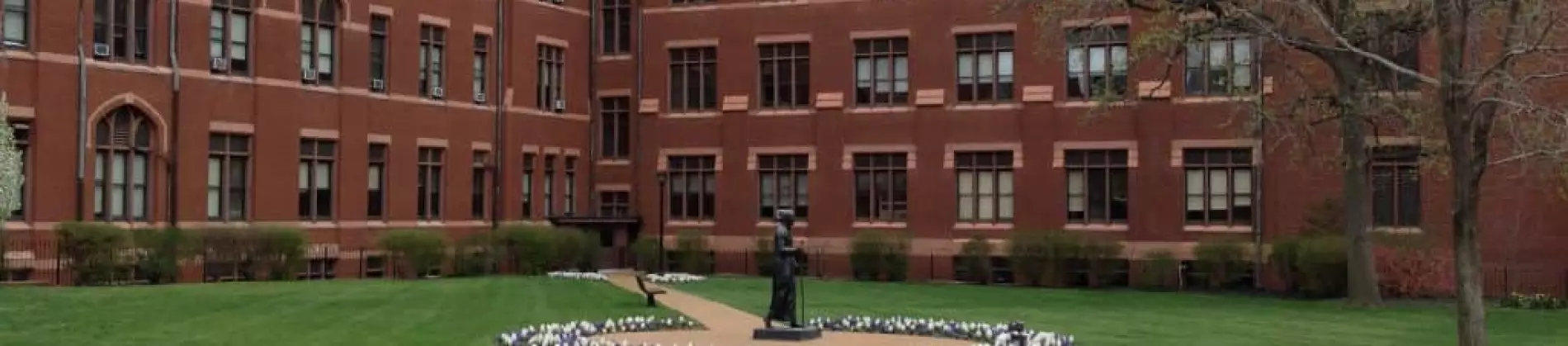
Bachelor of Medical Laboratory Science at Saint Louis University

    Bachelor of Medical Laboratory Science at Saint Louis University

    Bachelor of Medical Laboratory Science at Saint Louis University

    Saint Louis University offers the Bachelor of Medical Laboratory Science as a full-time degree delivered on campus at its main campus in Saint Louis , United States of America. Taught in English and completed over 4 years, the program equips students with the theoretical knowledge and practical skills required for medical laboratory science and related professional fields. The next available intake begins on August 23, 2027.

    About Bachelor of Medical Laboratory Science

    Saint Louis University's Bachelor of Science in Medical Laboratory Science (MLS) degree prepares graduates to take a national certification exam to become a certified laboratory professional for a career as a health care professional in laboratory medicine. Medical laboratory science professionals save lives by performing and assuring the reliability of tests that provide objective information used in the early detection, diagnosis, monitoring and effective treatment of disease.

    Up to 80% of all clinical decisions are impacted by clinical laboratory testing. The knowledge and skills required of medical laboratory professionals are diverse, involving both scientific detective work and managerial competence. Each day offers a challenge, and the opportunities to learn are endless.

    Additional program highlights include:

    • SLU's MLS program was one of the first in the country; it has over 85 years of continuous accreditation.
    • SLU's MLS program has guaranteed placement in clinical practicum training sites.
    • SLU's MLS program boasts both a low student-faculty ratio and state-of-the-art medical laboratory science labs – both of which help to substantially enhance the experience of students.
    • SLU's MLS graduates' exam pass rates are consistently at or near 100%, as is the graduate career placement rate.
    • Students in SLU's medical laboratory science program have numerous opportunities for personal and professional growth through faculty, professional and peer interactions. They have the opportunity to join professional organizations such as the American Society for Clinical Laboratory Science (ASCLS) and the American Society of Clinical Pathology (ASCP).

    1. Graduates will  demonstrate respect for human life with regard to all aspects of laboratory testing.
    2. Graduates will communicate accurate laboratory information to members of the healthcare team.
    3. Graduates will apply critical reasoning to solve laboratory-based case studies.
    4. Graduates will integrate knowledge of laboratory theory into practice.
    5. Graduates will adhere to the principles found in the American Society for Clinical Laboratory Science (ASCLS) Professional Code of Ethics.

    The Medical Laboratory Science student must possess or have the ability to achieve certain competencies to successfully complete the curriculum. These competencies include knowledge, skills and attitudes that are necessary for professional practice. The essential requirements outlined below are presented for applicants and matriculates to review and use to assess their ability to successfully complete degree requirements. If you have any questions regarding your ability to achieve any of these essential requirements you can clarify your concerns by contacting a faculty member within the Medical Laboratory Science Program. If you perceive you will require special accommodations to meet these requirements, you must notify your advisor or the BLS department chair to arrange for University level assessment.

    The Medical Laboratory Science student must be able to:

    • In course assignments and within the laboratory practice setting, apply theoretical knowledge, ethical practice and sound judgment in following problem situations to their logical conclusions.
    • Assimilate mathematical and scientific data to allow application of basic principles in concrete situations related to laboratory practice and test interpretation.
    • Physically manipulate themselves and small objects (20 pounds or less) within the laboratory/clinical/research setting in a safe and effective fashion.
    • Display a functional level of manual dexterity in the performance of laboratory testing including phlebotomy and numerous other laboratory procedures requiring delicate manipulations and in the utilization of computerized instrumentation.
    • Demonstrate functional use of their senses including but not limited to:
      • Visual acuity in distinguishing colorimetric endpoints and subtle microscopic differences between diagnostic elements in clinical specimen when examined under a microscope and/or displayed on a monitor.
      • Sense of touch to distinguish temperature discrimination for safety purposes.
      • Visual acuity and accurate transcription in the reporting of testing data and quality control information in a written or computer-generated format.
    • Utilize effective and respectful written and oral communication skills in professional interactions with patients, colleagues, and other health care professionals.
    • Accurately perform complex technical procedures under stressful working conditions (e.g. emergency situations, ambiguous orders, heavy workload, and a distracting and noisy environment) and within reasonable time constraints.
    • Comprehend and adhere to policies and regulations as prescribed by appropriate governing agencies. These policies are generally but not exclusively related to competent, ethical and safe practice. 
    • Submit to and receive a satisfactory report on criminal background checks and drug testing for substances of abuse.
    • Transfer applicants will be accepted on the basis of clinical site availability.

    Graduates of the MLS Program are eligible to take a nationally administered certification exam. Passing this exam indicates a knowledge base and skill set necessary to function as a healthcare professional. License and certification varies depending on the state in which you will practice. Currently 12 states require a license to practice as a clinical laboratory professional, including CA, FL, LA, MT, NV, NY, ND, RI, TN, WV, PR, GA.

    Certification Exam Pass Rate

    • SLU graduates consistently have a pass rate higher than the national average

    • Pass rate is usually at or near 100 percent

    Two certification exams are recognized nationally within the profession:

    • American Society for Clinical Pathology Board of Certification exam

    • American Medical Technology

    Licensure

    To practice in some states a licensure examination is also required by law. It is advisable to check with the individual state's department of health to determine if such an exam is required.

    For more information, visit https://www.ascp.org/content/board-of-certification/get-credentialed/#state-licensure

    Program Outcomes

    Graduate certification rates demonstrating an average of at least 75% pass rate.

    Accreditation Rates
    YearRate
    2019100%
    202086%
    2021100%

    Graduation rates demonstrating an average of at least 70% of students who have begun the final half of the program go on to successfully graduate.

    Accreditation Rates
    YearRate
    2019100%
    202078%
    2021100%

     Graduate placement rates demonstrating that an average of at least 70% of respondent graduates either find employment in the field or a closely related field (for those who seek employment), or continue their education within one year of graduation.

    Accreditation Rates
    YearRate
    2019100%
    2020100%
    2021100%

    Requirements and Admission Criteria for Bachelor of Medical Laboratory Science at Saint Louis University

    Entry Requirements

    Send transcripts of all secondary work.

    Find out from your admission counselor what secondary credentials are required. We’ll evaluate how you’ve done in school up to this point, so please send all transcripts for secondary work, along with their English language translations.

    Submit proof of your English language proficiency.

    These are scores from any standardized test you may have taken to prepare for college — TOEFL, IELTS, PTE, SAT, ACT or Duolingo score. All of our international applicants are required to demonstrate their English proficiency, and these tests can help us make that determination.

    If you do not meet SLU’s direct entry requirements, we encourage you to apply to the Pathway or English Language programs offered by INTO Saint Louis University.

    Recommended items.

    Though not required for admission, submission of a resume of activities and letters of recommendation is encouraged. All undergraduate applicants are also encouraged to complete an admission interview.

    English Requirements

    • PTEMin 54
    • IELTSMin 6.5
    • TOEFLMin 80

    Career Opportunities after Completing Bachelor of Medical Laboratory Science

    Medical laboratory scientists are vital members of health care teams. As highly skilled bioanalysts, graduates contribute data critical to disease diagnosis and to patient treatment. In a typical laboratory setting, the medical laboratory scientist performs a full range of laboratory tests, from blood smears to detect anemia to highly complex procedures used to diagnose and monitor the status of patients suffering from various forms of cancer.

    SLU's medical laboratory science program facilitates the attendance of its students at state professional meetings. In addition, clinical affiliates in the St. Louis area frequently request that students seek part-time employment to garner clinical experience and are often retained as full-time employees upon graduation.

    The benefits of SLU's medical laboratory science program include several career opportunities. Medical laboratory scientists are qualified to work in five major areas of the laboratory: blood bank, chemistry, hematology, immunology and microbiology.

    Throughout the course of a typical workday, graduates from this program might examine specimens under the microscope, operate complex computerized instrumentation, use immunologic methods to prepare units of blood for transfusion and/or identify disease-causing microorganisms.

    While most medical laboratory science graduates work in a clinical laboratory in diagnostic testing and laboratory management, some choose positions in research, forensic science/crime laboratories, laboratory equipment companies or pharmaceutical/biotechnology industries. Many graduates choose to go directly to graduate, medical or professional schools. According to the most recent American Society for Clinical Pathology (ASCP) wage survey, across the nation, staff-level MLS/MT/CLSs are paid an average salary of $68,240.

    Tuition and Fee Information for Bachelor of Medical Laboratory Science at Saint Louis University

    How to Apply for Bachelor of Medical Laboratory Science at Saint Louis University

    The online application will ask about your educational background and citizenship to help determine your eligibility. If you are applying to enter SLU as a first-time, freshman student, we’ll also ask you to complete an essay. There is no application fee to apply for undergraduate admission to SLU. 

    Bachelor of Medical Laboratory Science at Saint Louis University
    Saint Louis University
    Saint Louis University
    United States of America

    United States of America, Saint Louis

    WhatsApp student consultation with YouApply