
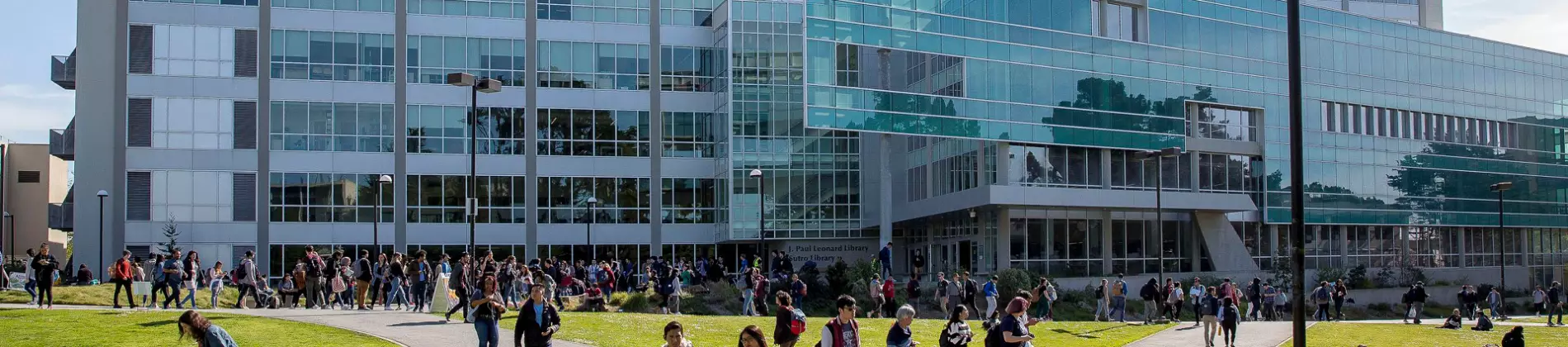
Bachelor of Journalism: Concentration in Photojournalism at San Francisco State University

    Bachelor of Journalism: Concentration in Photojournalism at San Francisco State University

    Bachelor of Journalism: Concentration in Photojournalism at San Francisco State University

    Study Journalism: Concentration in Photojournalism at San Francisco State University, a Bachelor degree offered at its main campus in San Francisco, United States of America. This Full Time program is delivered on campus in English and takes approximately 4 years to complete. Students benefit from a structured learning experience designed to build both theoretical knowledge and practical experience. The next intake is scheduled for August 16, 2027.

    About Bachelor of Journalism: Concentration in Photojournalism

    To earn a Bachelor of Arts in Journalism, students must complete 43 journalism units. Only ten journalism units may be in the lower-division for print/online majors –JOUR 205 and JOUR 221, JOUR 222, and JOUR 226, or their equivalents completed elsewhere. Only 13 units may be lower-division for photojournalism majors–JOUR 205 and JOUR 221, JOUR 222, JOUR 226 and JOUR 235, or their equivalents completed elsewhere. Courses numbered 300 and above are not open to freshmen. Upon enrolling in journalism classes, students will be required to use their SF State email accounts. These email addresses will be used as the primary source of communication between students and the department.

    To ensure that every journalism student's education is as rich and varied as possible, the department has established these requirements:

    • A journalism major must complete a minor in one of the areas of study approved by faculty advisors. A list of approved disciplines for this requirement is posted at https://journalism.sfsu.edu/approved-minors. Students should consult with an academic advisor in journalism to determine the minor that best meets their interests and professional goals.
    • A journalism major must have a minimum of 72 non-journalism units in the 120 minimum overall units required for graduation. Included in these 72 units must be a minor in a single subject area chosen in consultation with the advisor. The 72 unit requirement is consistent with the department's philosophy that a well-rounded education is crucial preparation for journalism and is consistent with the standards of the national accrediting agency (ACEJMC) that evaluates journalism education programs. These standards exclude classes in broadcasting (BECA), public relations (MKTG), and advertising (MKTG) from qualifying as non-journalism units. Photography and film production classes in Art, Cinema, and Design are also excluded.
    1. News Judgment: Work demonstrates news judgment that identifies and develops story ideas through observation, reading and paying attention to their environment
    2. Critical and Independent Thinking: Work demonstrates an ability to synthesize information, think independently, and work through problems using inference and logic.
    3. Cultural Competence: Work demonstrates an understanding of a variety of cultures and how those cultures influence perspectives, attitudes, and personal interaction with the world.
    4. Writing: Work demonstrates concise, clear, and accurate writing that engages the audience with compelling storytelling.
    5. Analytical Competence: Work demonstrates an ability to discern and weigh the quality of information they gather, as well as know-how to analyze and interpret it.
    6. Research and Reporting: Work demonstrates an ability to methodically find information through personal interviews, public documents, and the Internet.
    7. Media Literacy: Work demonstrates an ability to competently navigate through a rapidly changing media world, understanding media's influence on society, community, and the democratic process, and that students also understand the power of visual storytelling in shaping society's understanding of the world.
    8. Ethics, Integrity, and the Law: Work demonstrates knowledge and practice of ethical standards and constitutional laws that guide journalism excellence.
    9. Critical Evaluation: Work demonstrates critical evaluation of their own work and that of others for accuracy and fairness, clarity, appropriate style, and grammatical correctness.
    10. Data and Numbers: Work demonstrates an ability to apply basic numerical and statistical concepts.
    11. Technology: Work demonstrates an ability to know when and how to apply technology in their professional work.
    12. Visual Competence: Work demonstrates a technically competent ability to research, find and capture a concise and compelling story that reflects the gamut of human experience in a variety of formats.

    Requirements and Admission Criteria for Bachelor of Journalism: Concentration in Photojournalism at San Francisco State University

    Entry Requirements

    Shehaadat al-thaanawiya al-'aama | General Certificate of Secondary Education

    English Requirements

    • PTEMin 45
    • IELTSMin 6
    • TOEFLMin 61

    Tuition and Fee Information for Bachelor of Journalism: Concentration in Photojournalism at San Francisco State University

    Application Fee 70

    How to Apply for Bachelor of Journalism: Concentration in Photojournalism at San Francisco State University

    1. Explore and Choose a Major

    With more than 100 undergraduate majors to choose from, you can discover your unique path in life at SF State. Whatever you choose to study, you will learn from faculty experts who are dedicated to helping you develop your potential.

    2. Apply Online

    Apply online at www.calstate.edu/apply during the filing period (see Dates & Deadlines).

    A $70 (non-refundable) application fee is due at the time of submission and can be paid by credit card or PayPal. 

    Use this International Student Application Checklist to gather the information you will need to complete your online application.

    SF State uses your self-reported information from the application to make an admission decision, so it is extremely important that you answer all questions on the application completely and accurately.

    3. Submit any requested documents

    Once we review your application we will notify you by email with instructions and deadlines should we need any additional documents.

    4. Check your application status

    San Francisco State communicates with students via e-mail. Make sure to read all e-mail messages and pay careful attention to deadlines.

    Check your application status to ensure all supporting materials have been received.

    Bachelor of Journalism: Concentration in Photojournalism at San Francisco State University
    San Francisco State University
    San Francisco State University
    United States of America

    United States of America, San Francisco

    WhatsApp student consultation with YouApply