

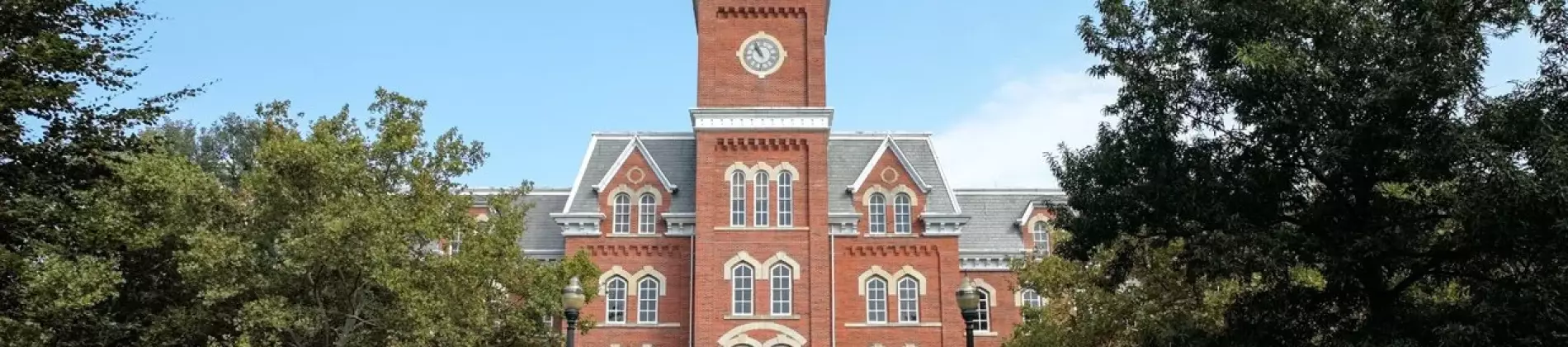
Bachelor of Pre-Veterinary Medicine at The Ohio State University

International students can study the Pre-Veterinary Medicine at The Ohio State University on the Columbus campus in United States of America. This Bachelor degree is available as a Full Time program delivered on campus in English. The program has a duration of 4 years and is offered at the Columbus campus. Students can apply for the next intake starting on August 24, 2027.
About Bachelor of Pre-Veterinary Medicine
Pre-Veterinary Medicine
Campus: Columbus
Program: Pre-Professional
The College of Veterinary Medicine offers the Doctor of Veterinary Medicine (DVM) degree in one of the senior health professions at Ohio State. The DVM degree prepares graduates to diagnose, treat and prevent animal diseases as well as promote public health, conserve animal resources, and promote the bond between humans and animals. Veterinarians serve to advance medical knowledge through research, serve as a valuable resource for the biomedical community, and provide both general and specialized care to animal patients and their owners.
Veterinarians must be licensed in order to practice veterinary medicine in a given state. Licensure is regulated by the Veterinary Medical Board. Ohio State academic programs are designed to prepare students to apply for applicable licensure or certification in Ohio. If you plan to pursue licensure or certification in a state other than Ohio, you can review state educational requirements for licensure and certification at go.osu.edu/onground. You'll also find contact information for other state licensing boards; as requirements may change, you should contact the applicable licensing board before beginning an academic program.
Pre-professional programs
Pre-professional is a category for any student who intends to enter professional school after graduating with a bachelor’s degree. Pre-health is the pre-professional program for students interested in the health professions, including dentistry, medicine, optometry, pharmacy, physical therapy and veterinary medicine. Identifying your pre-professional interest will enable your college advisor, your major advisor and your pre-professional advisor to provide you with a wide range of support to realize your goals.
Get started
Contrary to popular belief, there is no one “best†major at Ohio State in which to prepare for the College of Veterinary Medicine. Students generally select a course of study that is related to the life sciences, such as biology, zoology or animal science, but there really are no limits as long as the necessary prerequisite course work is integrated into the undergraduate major.
Although a majority of veterinary applicants complete an undergraduate degree and then apply for admission to the professional program, a bachelor’s degree is recommended but not required for admission to the College of Veterinary Medicine. All applicants should demonstrate progress toward a four-year bachelor’s degree as they are working on completing their three years of prerequisite course work for admission to the College of Veterinary Medicine.
Each year the college admits 162 new veterinary students. Admission to the College of Veterinary Medicine is based on the following:
- completion of prerequisite course work
- participation in non-academic activities (volunteering, community service, work history, military service, sports)
- exposure to the profession
- personal interview
A strong science foundation, as well as elective courses in the social sciences and humanities, make up the prerequisite curriculum at Ohio State. Admission to the College of Veterinary Medicine requires completion of the following prerequisite courses by the end of the summer term preceding the autumn term a student would start veterinary school:
- Biochemistry 4511
- Microbiology 4000
- Physiology 3200
- Communication 2110
- 35 credit hours of science electives
- 16 credit hours of humanities and social sciences electives
Biochemistry, microbiology, physiology and communication course work must be completed with a grade of C or better in each course, a minimum of a 3.0 (B) average among the courses, and no more than one C among any of the capstone courses. If any of the capstone courses are taken as a multiple-part series, this rule applies to each part as an individual course. Contact [email protected] for any questions regarding prerequisite courses.
Curriculum
The veterinary medicine curriculum spans four years. In the first three years, students take preclinical course work; classes will includ clinical skills courses, labs and didactic courses. The final year of course work is spent rotating through clinical experiences.
During the first year, students average 20 credit hours per semester and take topographic anatomy, functional histology, epidemiology, cell biology, comparative biology of disease, pharmacology, musculoskeletal system and clinical pathology. They will also take the first of a series of courses in professional development and clinical skills which continue throughout the rest of the preclinical curriculum.
During the second year, students concentrate on organ systems in health and disease. The courses teach the cardiovascular, respiratory, neurological, reproductive, endocrine, gastrointestinal, urinary and integumentary systems. Students will also learn veterinary preventive medicine, animal welfare, parasitology and ophthalmology, as well as continue their professional development and clinical medicine courses. Students will take an average of 20 credit hours per semester.
The third and fourth years are one continuous experience, as students take no summer break between these years. The first part of the third year consists of further body systems and laboratory courses in clinical skills, introduction to surgery and small animal operative practices. Senior students have the opportunity to select a career area of emphasis for their senior clinical rotations. The opportunity to specialize allows students to make career choices based on personal interest. All seniors are required to complete core rotations that cover all major domestic species. These rotations include anesthesia, pathology, radiology, food animal, equine and small animal rotations. Their choice of focus determines their remaining core rotations, and they also have the opportunity to complete three to four elective rotations.
Internship
Students are encouraged to explore the profession on their own, whether through work or volunteer experience with a veterinary practice or informational interviews with people in the profession. Students can gain experience by exploring a variety of veterinary career paths to develop a strong knowledge and understanding of the profession.
Student organizations
Pre-veterinary medicine students are encouraged to be a part of the pre-veterinary medicine club. The club is student run with a veterinary medicine faculty advisor. The club sponsors a variety of activities to help students become more aware of and knowledgeable about the veterinary profession. Speakers at monthly meetings might include a faculty member sharing his or her research about a particular aspect of veterinary medicine or a veterinarian from the community. Activities coordinated by the club, including community service activities and social functions, help pre-veterinary students get to know one another outside the academic setting.
Possible careers
There are a wide number of career opportunities available to veterinarians today. The majority of DVMs are in some form of private practice. In private practice, veterinarians work directly with the owner of an animal patient to diagnose and treat ill animals, as well as to prevent illness in healthy animals. Practicing veterinarians may be in a general (mixed animal) practice or they may limit their practice to a particular animal species. Other veterinarians in private practice have sought additional education and attained specialty board certification (e.g., Veterinary Internal Medicine, Veterinary Radiology or Veterinary Pathology).
For those who desire public service, there are many veterinarians serving as public health officers for the U.S. Government, the World Health Organization, and every state in the United States, as well as for many other organizations.
Additionally, veterinarians are actively engaged in teaching, research, regulatory veterinary medicine, military service and other aspects of the profession. In short, the profession opens many doors to its members.
Salary estimates
As there are many career options available within the veterinary profession, salaries vary. Graduates who pursue the practice route can expect a starting salary between $75,000 and $100,000. Graduates who pursue a specialty area may first need to complete additional years of training, but can expect salaries as board-certified veterinarians between $120,000 and $200,000.
Requirements and Admission Criteria for Bachelor of Pre-Veterinary Medicine at The Ohio State University
Entry Requirements
Criteria of our holistic review, in no particular order.
Successful completion of university preparatory courses
High school performance (class rank or GPA), including participation in accelerated programs like Honors, AP and IB; Ohio State does not have minimum requirements for class rank or GPA
Standardized test score (ACT or SAT); Ohio State does not have minimum requirements for ACT or SAT scores
Ohio State has adopted a TEST-OPTIONAL policy for 2022 applicants. Learn more.
Ability and desire to contribute to and engage with a diverse campus community
Experiences that demonstrate leadership or engaged involvement (e.g., co-curricular activities, work experiences or military service)
Status as a first-generation university student
Demonstration of outstanding talent in a particular area
High school performance if adversely affected by physical, mental or learning environment factors
Eligibility for and likelihood of benefiting from organized support services at Ohio State
Enrollment in your intended major
Once it is determined that you are admissible, you will be considered for enrollment in the college of your intended major. Read about
English Requirements
- IELTSMin 6.5
- TOEFLMin 79
English Program Requirements
we require evidence of English language proficiency, unless you have completed three full years of school at a U.S. regionally accredited high school or if you are a citizen of, or have received a bachelor’s degree from, Australia, Belize, British Caribbean, British West Indies, Canada (except Quebec), England, Guyana, Ireland, Liberia, New Zealand, Scotland, the United States or Wales.
Tuition and Fee Information for Bachelor of Pre-Veterinary Medicine at The Ohio State University
How to Apply for Bachelor of Pre-Veterinary Medicine at The Ohio State University
How do I submit scores?
Ohio State has adopted a TEST-OPTIONAL policy for 2022 applicants. Learn more.
Tips for sending scores to Ohio State
Scores must come directly from the testing agency. When you register for the ACT or SAT, indicate that you want your scores sent to Ohio State.
If you already took the test but didn't send your scores to Ohio State, you can order them for a fee. Order in advance to be sure scores reach us by the application deadline.
We must receive standardized test scores by your application deadline (either November 1 or February 1 for autumn semester applicants).
October 2 (SAT) and October 23 (ACT) are your last 2021 test dates if you want your scores to be considered for our November 1 early action deadline. Important! If you plan to test on those dates, you must request that Ohio State receive scores when you register for the test. And please note: If you choose to have your scores considered, you won’t be able to review scores from these dates prior to submitting your application by the November 1 deadline.
Applicants who will have been out of high school for two or more years by their term of enrollment are not required to submit scores.
Is the essay required?
The essay is not required for either the ACT or SAT.
Should I take a standardized test more than once?
Ohio State looks at the highest composite score from a single test date. Taking the test (and having scores sent to us) more than once, while not required, may work to your advantage.
How does Ohio State look at scores?
When considering students for admission or Honors and Scholars selection, we consider the best official composite / combined score from a single test administration. Ohio State does not mix sub-scores from multiple tests.
These items plus the Common Application (STEP 3) make up a complete application. We must receive all items by the deadline to consider your application on time.
Official transcripts
High school transcripts
Request that your high school or secondary school send transcripts / documents / official copies of examination certificates for coursework from the final four years (grades 9-12) to Ohio State.
How to send your transcripts to Ohio State:
Your high school counselor can upload the transcripts / documents / official copies of examination certificates using Common App, Naviance or other secure electronic delivery service.
Your high school counselor can email the transcripts to [email protected].
If electronic submission is not possible, please mail your official transcripts to our express mail address.
Faxed transcripts will not be accepted.
Foreign language documents must be translated into English by the issuing institution, an authorized translator or a teacher of the language. Any additional requirements will be posted to your Applicant Center, so be sure to check your application status regularly after you've applied.
Official ACT or SAT scores
Ohio State has adopted a TEST-OPTIONAL policy for 2022 applicants. Learn more.How do I submit my scores?
We must receive your official ACT or SAT score sent electronically directly from the testing agency. Scores from transcripts will not be considered. Read more about score requirements in STEP 1.
Optional: Recommendation from a teacher or counselor
While not required, your counselor may send a maximum of two letters of recommendation electronically through the Common Application.
If an electronic option isn’t available, your counselor may email your letter(s) to
[email protected]; the letter must include your first and last name and OSU ID number, found on the email we send acknowledging receipt of your application. Letters sent via email are subject to sender verification.
Official proof of English language skills
You must request that your testing agency send official scores electronically to Ohio State demonstrating the English proficiency level outlined below:
TOEFL (internet-based test or internet-based test Home Edition*): 79 or higher
IELTS or IELTS Indicator*: 6.5 or higher
ACT: 21 or higher on the English section
SAT: 27 or higher on the Reading Test
Duolingo*: 105 or higher
You are exempt from this requirement if you have completed three full years of school at a U.S. regionally accredited high school or if you are a citizen of, or have received a bachelor’s degree from, Australia, Belize, British Caribbean, British West Indies, Canada (except Quebec), England, Guyana, Ireland, Liberia, New Zealand, Scotland, the United States or Wales.
Ohio State has an intensive English program for students who wish to improve their language skills called the American Language Program. A separate application is required for this program. Ohio State does not offer conditional admission to students who enroll in the American Language Program.
*To accommodate applicants affected by the COVID-19 pandemic, The Ohio State University will accept Duolingo, the IELTS Indicator and the TOEFL internet-based test Home Edition from any international student applying for spring 2022 or autumn 2022 admission. All Duolingo test takers are required to take an English placement exam upon arrival to campus. TOEFL Home Edition and IELTS Indicator test takers are required to take an English placement exam upon arrival unless they qualify for a TOEFL or IELTS score exemption.

United States of America, Columbus