

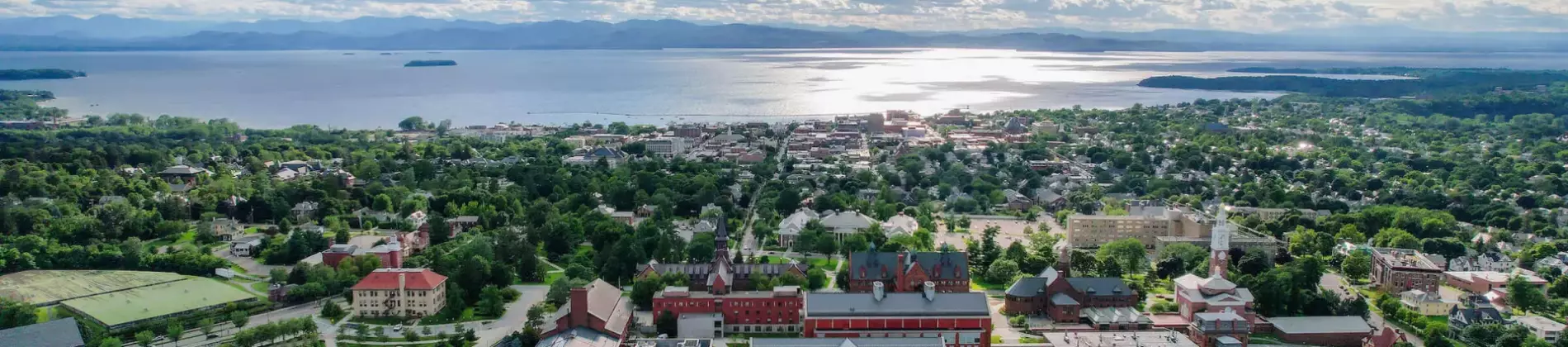


The Department of Geography celebrated fifty years of teaching and research at UVM in 2016-2017. For five decades the department has developed a scholarly profile in the College of Arts and Sciences and the University, highlighting spatialized thinking about social and natural environments, from local to global scales of analysis. We also participate in the interdisciplinary Geospatial Technologies minor, and in interdisciplinary undergraduate degree programs in Critical Race and Ethnic Studies, Environmental Sciences, Environmental Studies, Global and Regional Studies, Gender, Sexuality, and Women's Studies, and Vermont Studies. Explore the learning goals (PDF) addressed in our curriculum. We conduct an annual assessment of our curriculum using this plan (PDF).
How does a degree in Geography prepare graduates for the world?
The study of geography at the university level equips students with many of the same analytical
and conceptual skills as other liberal arts disciplines, but our emphasis on understanding the spatial dimensions of both physical and human phenomena is unique. Further, the study of Geography trains students to appreciate the importance of a broad, international, interdisciplinary and comparative perspective. A Geography major provides students with technical skills, a focus on environment and society, and local-regional-global interpretive capacity that is increasingly important for an informed citizenry. A Geography minor provides students with a foundation in human and/or physical geography, geographic techniques, regional studies and important subdisciplinary fields such as urban/rural studies, climate studies, and political ecology. Our graduates go on to graduate programs in Geography or cognate fields at some of the best programs in the country and develop careers in academia, education, law, governmental and nongovernmental organizations, consulting, and the field of international development. Upon completion of the BA degree, students will be able to:
1. Demonstrate familiarity with the breadth of the discipline of Geography and deeper comprehension of at least one subfield
2. Identify and articulate the connections between theoretical concepts and empirical data
3. Demonstrate basic competence in the research methods of Geography, as well as the ability to produce and assess representations of geographical data
4. Conduct clear and rigorous communication through written and oral means
5. Critically engage with and contribute to the production of knowledge through the review of existing scholarship and the conduct of original research using Geographic skills
How are courses in Geography structured?
Geography courses are taught at the introductory (00-), intermediate (100-), and advanced (200-) level. Introductory courses are offered either as lectures or as first-year seminars, giving students an opportunity to learn about the breadth of the discipline and some of the problems and challenges Geographers take on. Intermediate courses dive into the subfields, building strength in writing and analysis. Advanced courses are offered in small seminar format, with high-levels of discussion, a research or project experience (often with community partners) and opportunities to get out "into the field."
The Geography Department recently changed its major requirements. Students entering in AY 2016-17, 2017-18, and 2018-19 follow the major requirements posted here. Students entering in AY 2019-20 and later follow the major requirements posted here. The Department is implementing some flexibility with the "methods" course requirement as we transition into the new major requirements. Students should speak with their advisor or the department chair about options for satisfying the "methods" requirement.