

The Marine Biology (MB) option is intended for students interested in marine, coastal, and estuarine ecosystems, and the organisms that inhabit them, at all levels of inquiry. Some UNH faculty use marine organisms as model systems for molecular phylogeny, cellular metabolism, and neurobiology, while others study the structure and function of marine ecosystems. Some faculty members focus primarily on basic research; others work in applied areas such as aquaculture and fisheries; many combine the two. Students who have earned advanced degrees at UNH lead agencies involved in managing valuable marine resources, teach marine biology in academic and public settings, own aquaculture companies, or earn a living as researchers. In addition to on-campus facilities, UNH owns the Coastal Marine Laboratory and the Jackson Estuarine Laboratory, and a range of research vessels. UNH has an excellent SCUBA diving program for students interested in becoming certified to dive as part of their research. The Marine Biology option is also affiliated with UNH's School of Marine Sciences and Ocean Engineering.
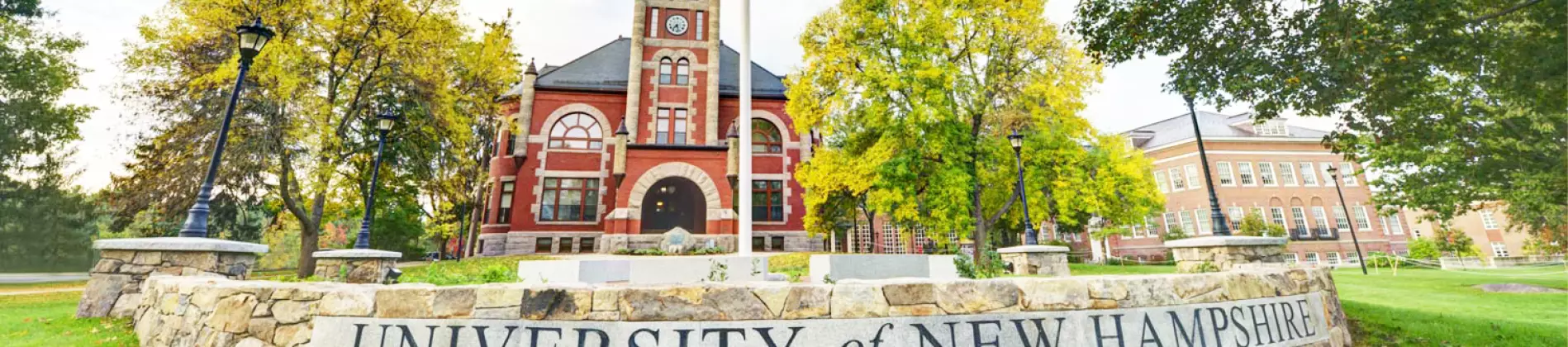
Master of Marine Biology at University of New Hampshire

University Rank:#1001
Master of Marine Biology at University of New Hampshire
University of New Hampshire offers the Master of Marine Biology as a full-time degree delivered on campus at its main campus in Durham , United States of America. Taught in English and completed over 2 years, the program equips students with the theoretical knowledge and practical skills required for marine biology and related professional fields. The next available intake begins on August 28, 2027.
About Master of Marine Biology
- Students will demonstrate expertise in quantitative skills including (a) basic math and statistics; (b) spreadsheet software; (c) graphical presentation of quantitative data.
- Students will demonstrate writing skills that enable them to prepare a scientific research paper in standard format for their field.
- Students will demonstrate competency in experimental design, including the ability to articulate a testable hypothesis and design an appropriate experiment to test it.
- Students will demonstrate communication skills including the ability to clearly explain scientific information to both professional and general audiences.
- Students will demonstrate broad understanding of fundamental areas of biology, especially areas relevant to their research project.
Requirements and Admission Criteria for Master of Marine Biology at University of New Hampshire
Entry Requirements
- Transcript evaluation by a third party is not required as long as an application is in English. Translation services and evaluation services may be requested at the discretion of the academic department.
- Transcripts from all previous post-secondary institutions must be submitted and applicants must disclose any previous academic or disciplinary sanctions that resulted in their temporary or permanent separation from a previous post-secondary institution. If it is found that previous academic or disciplinary separations were not disclosed, applicants may face denial and admitted students may face dismissal from their academic program.
- International applicants may submit copies of official transcripts by emailing [email protected]. We will upload those transcripts to your application checklist.
- Official transcripts will be required if admitted. These can be hand-delivered in a sealed envelope upon arrival, emailed to [email protected], or mailed hardcopy to UNH Graduate School, Thompson Hall, 105 Main Street, Durham, NH 03824.
English Requirements
- PTEMin 59
- IELTSMin 6.5
- TOEFLMin 80
Tuition and Fee Information for Master of Marine Biology at University of New Hampshire
Application Fee 65
How to Apply for Master of Marine Biology at University of New Hampshire
STEP 1: APPLY ONLINE
- Program-specific application requirements
- To understand the cost of attendance view the Tuition & Financial Aid information.
- Complete the Application Form: Once your application is submitted it cannot be changed in the application platform. Contact the Graduate School to make any updates.
- Review Forms and Policies page: Important documents you may need are available on this webpage.
- Click button below for Application Instructions:
STEP 2: SUBMIT DOCUMENTS
- Submit Documents: Copies of official transcripts from all previous post-secondary institutions should be uploaded through the application form. If your program requires the GRE/GMAT (check here), please have scores sent to the UNH Graduate School by the testing service.
- Transcripts: Transcripts are required for all post-secondary institutions that you attended. If admitted to the program, you will need to request that transcripts be sent to ([email protected]) via email or hardcopy to UNH Graduate School, Thompson Hall, 105 Main Street, Durham, NH 03824.
- International Students: Official English language score reports (such as TOEFL) must be sent to the UNH Graduate School by the testing service. Internationals who graduated as an undergrad from UNH will have the TOEFL waived.
STEP 3: MONITOR YOUR APPLICATION
- Monitor Your Status: After you’ve submitted your application, you can monitor when we’ve received your transcripts, recommendation letters, test scores, etc., by logging into your application portal.
- View your Decision and Respond to Offer of Admission: Once a decision has been made on your application you will be able to view it by logging into your application portal. Your decision letter will be available for print or download once it is viewed. Follow the instructions below:
- Visit the Application Portal
- Click the blue button, that says "View Your Decision"
- If admitted you will see a green button in the lower right-hand corner titled "Reply To Offer" through which you will be able to accept or decline your offer.
Master of Marine Biology at University of New Hampshire
University of New Hampshire

United States of America, Durham