
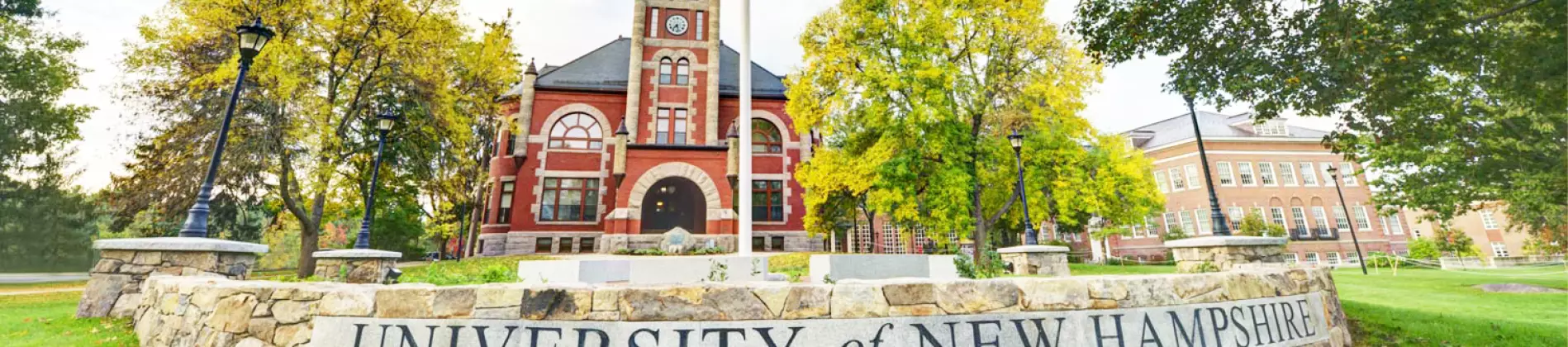
Master of Writing at University of New Hampshire

    Master of Writing at University of New Hampshire

    Master of Writing at University of New Hampshire

    International students can study the Writing at University of New Hampshire at its main campus in Durham , United States of America. This Master degree is available as a Full Time program delivered on campus in English. The program has a duration of 2 years and is offered at the university's main campus. Students can apply for the next intake starting on August 28, 2027.

    About Master of Writing

    The MFA Program in Writing at the University of New Hampshire has a clear and abiding focus: to help you shape your gifts and passion for the art, and to prepare you for the opportunities and demands that all writers will experience in a long professional career. Over the years, the graduate writing program has launched the careers of hundreds of poets, novelists, storywriters, essayists and memoirists. This is a small, highly-ranked, and selective program. We emphasize one-on-one contact between a nationally recognized faculty and talented students. Students typically complete the program in two to three years.

    We are most proud of the supportive community we have created here, one in which cross-genre exploration is strongly encouraged. Six out of ten of our MFA students receive direct financial aid, with most funding taking the form of teaching assistantships, tuition scholarships, and grant awards. Other opportunities include paid internships in local arts organizations, and editorial positions at our on-line journal Barnstorm.

    We also run an exciting visiting writers' series, so that students have a chance to connect with some of the finest contemporary poets, novelists and essayists currently at work. Add to all this the fact that we're located in a stunningly beautiful spot, close to mountains and sea coast, but within an hour of Boston and other cosmopolitan areas. We can't imagine that there is a more energizing and congenial place to pursue your talents and dreams anywhere in the country.

    Fiction

    The fiction program centers on your fiction. The one goal of our two years together is to make your fiction stronger, more aesthetically powerful, and yes, more publishable. The small 10-person workshop, intense conferencing with multiple award-winning faculty such as Ann Joslin Williams and Tom Paine, craft seminars that range from "Joyce and Chekhov" to Novellas and Contemporary Short Story Collections", special topics classes on "American Short Fiction by Women" and "Sentence Experiments in Literary Fiction", an esteemed reading series that brings authors such as Dan Chaon and Elissa Schappell to class and campus, our nationally known literary magazine Barnstorm: all of this is here simply to advance your fiction. Maybe it is because we are in the Granite State, but what is notable in our program is not just how hard students work on their own fiction, but how much effort goes into their response to the work of their peers. Writers here care deeply about each other as people, and the production of honest work that captures life on the page.

    Nonfiction

    Our narrative nonfiction program embraces a wide variety of forms, from memoir to travel writing, literary journalism to the personal essay and all of its permutations. Our focus, however, is not on labels but on nurturing your talent and developing your skills with the goal of helping you craft rich, compelling and publishable essays, stories and books. In short, we toil together to make facts dance. In our workshops and seminars we ask our students to read broadly and push themselves beyond their comfort zone, to experiment and exercise an array of literary muscles, to employ the imagery of a poet, the drama of a novelist and the content drive of a journalist. Our classes are small (average size is ten) and students meet frequently with instructors in individual conferences. As practical as the state of New Hampshire, our program emphasizes not only the art of writing narrative nonfiction, but also how to sell it. In one course students will learn how to write a book proposal and in others how to pitch travel stories and personal essays. The UNH nonfiction faculty is diverse in its expertise but united in its passion for reading and writing the literature of fact, and for sharing that passion.

    Poetry

    We offer poetry workshops limited to 10 students and small seminars in craft and poetics in a dynamic, individual-oriented system that emphasizes intensive conferencing. Students have the chance to work with master teachers like the award-winning poets Mekeel McBride and David Rivard. We believe in grounding our students in the widest possible range of poetic technique and approach–with seminars offered in areas such as translation, 20th-century poetic movements, and ecstatic poetry–and no preconceived notions as to how anyone should write (other than well!). The poetic tradition of New England–one of the richest and most expansive in the world–serves as a backdrop for all our efforts. This is an area teeming with great poets, with numerous weekly opportunities for students to attend readings and lectures in the art.

    • Have a firm grasp of all the elements of craft whether fiction, poetry or nonfiction, including narrative structure, imagery, dramatic tension, efficient dialogue, and believable character.
    • Demonstrate expertise in the stylistic functions of language, including the use of simile and metaphor, unique language as opposed to clichés, resonating images or details, using all points of view, whether first, third or omniscient.
    • Understand the role of research and external content to provide context, layers, and credibility.
    • Be able to significantly revise work.
    • Have experience reading out loud and presenting to an audience.
    • Be able to flourish in the workplace for jobs in publishing, editing, communication, public relations, television, screenwriting, social media, news, advertising or any job where a writer is needed.

    Requirements and Admission Criteria for Master of Writing at University of New Hampshire

    Entry Requirements

    • Transcript evaluation by a third party is not required as long as an application is in English. Translation services and evaluation services may be requested at the discretion of the academic department.
    • Transcripts from all previous post-secondary institutions must be submitted and applicants must disclose any previous academic or disciplinary sanctions that resulted in their temporary or permanent separation from a previous post-secondary institution. If it is found that previous academic or disciplinary separations were not disclosed, applicants may face denial and admitted students may face dismissal from their academic program.
    • International applicants may submit copies of official transcripts by emailing [email protected]. We will upload those transcripts to your application checklist. 
    • Official transcripts will be required if admitted. These can be hand-delivered in a sealed envelope upon arrival, emailed to [email protected], or mailed hardcopy to UNH Graduate School, Thompson Hall, 105 Main Street, Durham, NH 03824.

    English Requirements

    • PTEMin 59
    • IELTSMin 6.5
    • TOEFLMin 80

    Tuition and Fee Information for Master of Writing at University of New Hampshire

    Application Fee 65

    How to Apply for Master of Writing at University of New Hampshire

    STEP 1: APPLY ONLINE

    • Program-specific application requirements
      • To understand the cost of attendance view the Tuition & Financial Aid information.
    • Complete the Application Form: Once your application is submitted it cannot be changed in the application platform. Contact the Graduate School to make any updates.
    • Review Forms and Policies page: Important documents you may need are available on this webpage.
    • Click button below for Application Instructions:

    STEP 2: SUBMIT DOCUMENTS

    • Submit Documents: Copies of official transcripts from all previous post-secondary institutions should be uploaded through the application form. If your program requires the GRE/GMAT (check here), please have scores sent to the UNH Graduate School by the testing service.
    • Transcripts: Transcripts are required for all post-secondary institutions that you attended. If admitted to the program, you will need to request that transcripts be sent to ([email protected]) via email or hardcopy to UNH Graduate School, Thompson Hall, 105 Main Street, Durham, NH 03824.
    • International Students: Official English language score reports (such as TOEFL) must be sent to the UNH Graduate School by the testing service. Internationals who graduated as an undergrad from UNH will have the TOEFL waived.

    STEP 3: MONITOR YOUR APPLICATION

    • Monitor Your Status: After you’ve submitted your application, you can monitor when we’ve received your transcripts, recommendation letters, test scores, etc., by logging into your application portal.
    • View your Decision and Respond to Offer of Admission: Once a decision has been made on your application you will be able to view it by logging into your application portal. Your decision letter will be available for print or download once it is viewed. Follow the instructions below:
      • Visit the Application Portal
      • Click the blue button, that says "View Your Decision"
      • If admitted you will see a green button in the lower right-hand corner titled "Reply To Offer" through which you will be able to accept or decline your offer.
    Master of Writing at University of New Hampshire
    University of New Hampshire
    University of New Hampshire
    United States of America

    United States of America, Durham

    WhatsApp student consultation with YouApply