
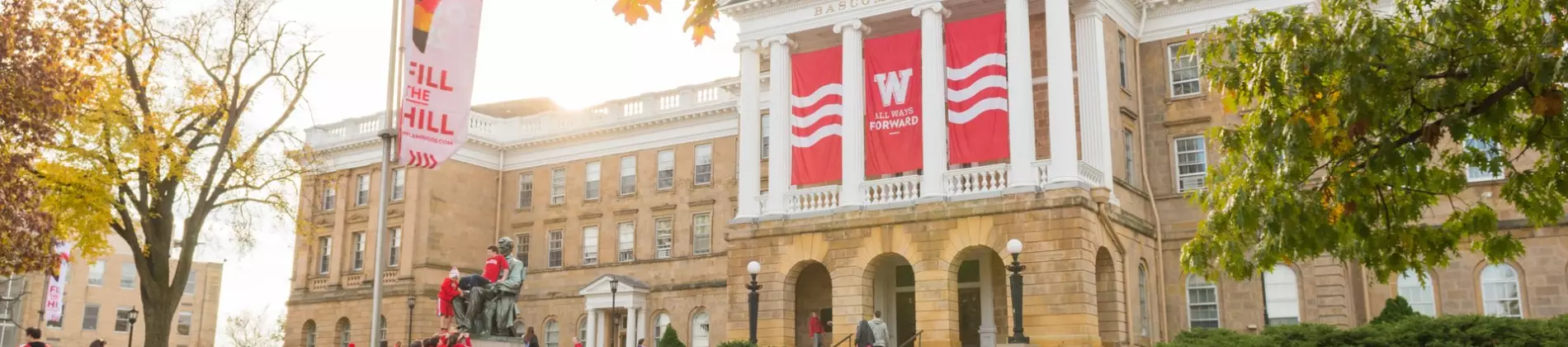
Sociology, B.A. at University of Wisconsin Madison

    Sociology, B.A. at University of Wisconsin Madison

    Sociology, B.A. at University of Wisconsin Madison

    University of Wisconsin Madison offers the Bachelor of Sociology, B.A. as a full-time degree delivered on campus at its main campus in Madison , United States of America. Taught in English and completed over 4 years, the program equips students with the theoretical knowledge and practical skills required for sociology, b.a. and related professional fields. The next available intake begins on September 7, 2027.

    About Sociology, B.A.


    Sociology applies the methods of science to explain social behavior. The interactions of individuals in families, groups, or organizations, and the institutions, social class, or shared beliefs of a common culture are all subjects for sociological research. There are many career opportunities open to people who complete a major in sociology, including business, counseling and social service, public policy, law, and criminal justice.

    Students interested in sociology should meet with the undergraduate advisor before they register for the second semester of the sophomore year. The undergraduate office's resource center holds detailed information about the major, the department, research interests of sociology faculty, career opportunities, and student work. Declaration of the major during the sophomore year will give students access to required sociology courses for fall of the junior year.

    Criminal Justice Certificate

    Sociology majors wishing to earn a certificate in criminal justice may do so with a minimum of additional course requirements and permission of the Criminal Justice advisor. See Criminal Justice section in this Guide.

    Enrollment

    Required courses for the sociology major and for the CAR option may have temporary course controls that send non-declared students "Course Requisites Not Met" enrollment error messages. Certain 100-numbered courses each semester are restricted to freshmen and sophomores until freshmen have enrolled. Check the Course Guide for notes each semester.

    Transfer students whose equivalent courses have been posted to their records as electives,” numbered XXX, may use those courses as prerequisites if the department approves their equivalencies to similar UWMadison courses. What is needed is a conversation with the undergraduate advisor either in the office or at SOAR.

    Honors Program

    A variety of courses in sociology offer honors credit, and may be used toward Honors in the Liberal Arts in the College of Letters & Science. These include the special honors introductory seminar, Sociology 181, Sociology 380 Contemporary Population Problems, other special honors sections of 100- and 200-level courses, and courses that provide honors by arrangement with the instructor. Sociology also has courses that award automatic honors, including SOC/​C&ESOC361 Statistics for Sociologists II, SOC362 Statistics for Sociologists III and SOC/​C&ESOC693 Practicum in Analysis and Research, and certain other upper-division courses designated by semester in the Course Guide. Sociology also makes special offerings of upper-level courses available to sophomores in the honors program for one semester at a time.

    Prerequisites, L&S BREADTH, and Course Levels

    Sociology course numbers over 300 indicate subject matter rather than level of difficulty. Unless indicated otherwise, prerequisites at the upper level are junior standing and an introductory course in sociology or consent of instructor.

    Most courses in sociology count toward the social studies breadth requirement. Courses SOC/​GEN&WS200 Introduction to Lesbian, Gay, Bisexual, Transgender and Queer+ Studies, SOC/​ASIAN/​GEOG/​HISTORY/​POLISCI244 Introduction to Southeast Asia: Vietnam to the Philippines, and SOC/​AFRICAN/​AFROAMER/​ANTHRO/​GEOG/​HISTORY/​POLISCI277 Africa: An Introductory Survey count toward breadth requirements in either humanities or social studies. The following do not count toward any breadth requirement:

    Course List
    CodeTitleCredits
    SOC/​C&ESOC357 Methods of Sociological Inquiry3-4
    SOC/​C&ESOC360 Statistics for Sociologists I4
    SOC/​C&ESOC361 Statistics for Sociologists II3
    SOC362 Statistics for Sociologists III3
    SOC496 Topics in Sociology1-3
    SOC/​C&ESOC693 Practicum in Analysis and Research3
    SOC/​LEGALST694 Criminal Justice Field Observation2-3

    1. Engage diversity and difference in practice.
    2. Advance human rights and social, economic and environmental justice.
    3. Engage in practice-informed research and research informed practice.
    4. Engage in policy practice.
    5. Engage with individuals, families, groups, organizations, and communities.
    6. Assess individuals, families, groups, organizations, and communities.
    7. Intervene with individuals, families, groups, organizations, and communities.
    8. Evaluate practice with individuals, families, groups, organizations, and communities.
    9. Demonstrate ethical and professional behavior.

    Requirements and Admission Criteria for Sociology, B.A. at University of Wisconsin Madison

    Entry Requirements

    All undergraduate students at UW–Madison must complete the university-wide General Education Requirements, which are designed to convey the essential core of an undergraduate education. This core establishes a foundation for living a productive life, being a citizen of the world, appreciating aesthetic values, and engaging in lifelong learning in a continually changing world. These requirements provide for breadth across the humanities and arts, social studies, and natural sciences; competence in communication, critical thinking, and analytical skills necessary for success in college and beyond; and investigation of the issues raised by living in a culturally diverse society. This core is intended to provide students with intellectual and practical skills, basic knowledge of human cultures and the physical world, strategies for understanding these topics, and tools intended to contribute to their sense of personal and social responsibility. General Education complements the work students do in their majors and degrees. Together, these requirements help students learn what they need to know not just for making a living, but also for making a life.

    Completing the General Education Requirements is an important part of achieving these competencies, and to do so, students choose from many courses in communication, ethnic studies, quantitative reasoning, and breadth of study across disciplines in the natural sciences, humanities, literature, and arts, and social and behavioral sciences.

    Completing the General Education Requirements is an important part of achieving these competencies, and to do so, students choose from many courses in communication, ethnic studies, quantitative reasoning, and breadth of study across disciplines in the natural sciences, humanities, literature, and arts, and social and behavioral sciences.

    Each school and college may choose to allow General Education courses to count toward other degree and/or major requirements. Students should always check with their advisors to discuss any additional degree requirements and determine if students are required to take specific General Education courses or to complete the requirements in a particular order. Students should review their Degree Audit (DARS) report to see how they are progressing toward fulfilling the General Education requirements. Please refer to.

    English Requirements

    • IELTSMin 6.5
    • TOEFLMin 80

    English Program Requirements

    Freshman applicants educated in non-English speaking countries must submit an official TOEFL, IELTS, or Duolingo English Test (DET) score, unless English was the primary language of instruction in all four years of secondary school.

    All English proficiency exams should be sent electronically, directly from the testing service.

    We do not superscore any English Proficiency exam and score reports cannot be older than two years from the time you apply.

    How to Send Official Test Scores

    Duolingo English Test (DET)

    • Minimum accepted score: 105+
    • When submitting your score(s): Search category should be “Undergraduate,” then select “University of Wisconsin–Madison”
    • Please do not send to offices listed under “Other,” as we are unable to retrieve those scores
    • The DET should be sent with sub-scores

    IELTS

    • Minimum accepted score: 6.5+
    • When submitting your score(s): IELTS does not require a code, so please select our account name, “University of Wisconsin, Madison Undergraduate”
    • Please do not send paper copies of your IELTS scores
    • We do accept the IELTS Indicator

    TOEFL iBT:

    • Minimum accepted score: 80+
    • When submitting your score(s): TOEFL test code is 1846
    • We do not accept “MyBest” score from TOEFL nor any English Proficiency exam
    • For each TOEFL you submit, we will require the full score report
    • We do not accept the TOEFL iTP Plus for China, but we will accept the iBT Special Home Edition

    If you feel that you qualify for an English Proficiency Exam waiver based upon the requirements above, please submit all required transcripts to our office. Other test scores such as ACT, SAT, or AP (Advanced Placement) scores do not meet the requirements for a waiver. Once your transcripts are received in our office (are no longer displayed on your to-do list in your Student Center), we will determine your waiver eligibility. Waivers will not be processed prior to receipt of both the admissions application and transcripts.

    Career Opportunities after Completing Sociology, B.A.

    Students interested in either the social welfare major or bachelor of social work meet with the social work advisors to discuss degree requirements; career opportunities; complete the major declaration; and confer on student issues and concerns. Advisors are an excellent resource for information about campus and community services. Students should see an advisor at least once each semester to review academic progress. Advising appointments are made through the school's website or by calling 263-3660. Social work faculty members are available for advice about course work, research, and the social work profession in general.

    BSW Ethnic Studies Requirement

    The BSW degree program requires six ethnic studies credits.  The BSW degree's minimum 47 credits assumes that three credits of the six-credit ethnic studies degree requirement will be met through SOC WORK 640, with the other three credits met as part of the Social Work electives, the Social Science Concentration, or other electives.

    Field Education

    The director of field education makes final unit placement decisions and field instructors make final agency-placement decisions.

    The types of agencies working with the field education program are varied. Field units are organized around a social problem area or a field of practice. Each unit has a range of field placement agencies and settings appropriate to its theme. The emphasis for undergraduate placements is on applying the knowledge and skills of generalist social work practice with systems of all sizes. The focus is on learning and applying analytic and interventive skills within an ethically based, problem-focused approach.

    Social work students should be advised that the Wisconsin Caregiver Law requires a Wisconsin background check (Caregiver Check and Wisconsin Criminal History) for all potential field-education students prior to the field placement. More information regarding this process is available at Field Education on the social work website.

    Senior
    FallCreditsSpringCredits
    SOC WORK 400 (A)5SOC WORK 401 (A)5
    SOC WORK 441 (I)3SOC WORK 612 (A)2
    SOC WORK 442 (A)2 
     10 7
    Total Credits 17

    For more information about field units, the agencies they work with, and field course expectations see the Field Education Handbook. Field unit availability may vary from year to year.

    This unit provides opportunities to work with human service agencies and community programs. The practice perspective is generalist social work in direct and indirect services to individuals, families, groups, organizations, and communities. The primary purpose of the field placement and seminar is to provide generalist practice opportunities for the development, integration and application of key competencies that are met through measurable practice behaviors. Theory and concepts learned in the classroom are integrated with practice opportunities, fostering the implementation of evidenced-informed practice. Participating Agencies: Bridge Lake Point Waunona, Goodman, Vera Court neighborhood centers; Center for Families; Dane County Court Appointed Special Advocates [CASA]; Disability Rights-Wisconsin; Second Harvest Food Bank; UW Medical Foundation; Youth Services of Southern Wisconsin (Briarpatch); YWCA (Girls Inc., House-ability, Third Street programs), Community Care Resources, Center for Families.

    This unit has been developed for generalist practice year students (BSW and first year MSW students) wanting to learn generalist social work practice in settings providing services to people with serious and persistent mental illness who are eighteen years of age and older. The placement settings include private non-profit mental health agencies, primarily providing comprehensive community support services. Participating Agencies: Most of the placements occur in programs of the Journey Mental Health Center’s Community Support Programs (CSP’s) including: Blacksmith House, Cornerstone, Gateway, Community Treatment Alternatives, Yahara House (day services program) and the Emergency Services Unit. Additional placements occur at: SOAR Case Management Services, Chrysalis, Badger Prairie Health Care Center, Tellurian UCAN’s Transitional Housing Program, William S. Middleton Memorial Veterans Hospital, and Mendota Mental Health Institute’s PACT (Program of Assertive Community Treatment), an outpatient program.

    This is a county (public) human/social service agency unit with practice including both direct and indirect services with clients, participants and communities. Students are involved in child welfare, child protective services, juvenile delinquency, foster care, institutional reintegration and community social work. Field placement activities include individual and family counseling, child and family assessment, case management, juvenile court services, foster care services, institutional reintegration, group work, neighborhood and community services and overall program planning. Students in this unit may have field placement settings in voluntary community agencies that work collaboratively with the county human services department. Students gain a solid understanding of the place of a county human service agency in the human services/child and family welfare system. Placements provide opportunities to learn, develop and demonstrate competencies through practice behaviors in all or most of the required social work competency areas. Field placements available through this unit are primarily located in Dane and surrounding counties. Depending on resource needs, this unit may include Title IV-E students. Participating Agencies: Division of Children, Youth and Families, Dane County Human Services, in the following specializations: Access and Initial assessment, Ongoing Services, Child Protective Services, Foster Care, Independent Living, Juvenile Delinquency, Institutional Reintegration, Neighborhood Intervention Program, and Joining Forces for Families (community social work). Placements may also be arranged in voluntary community agencies that have collaborative relationships with county human services.

    This unit has been developed for generalist practice year students who are interested in doing advocacy and promoting inclusive communities, especially with persons differing abilities. Since the objectives of the 400-level foundation year are primarily to teach and provide experiences in generalist social work practice, students will learn skills and knowledge applicable to a wide variety of social work settings. There is also the opportunity to work with two Madison-based programs doing international projects. Through work with individuals, families, groups, and communities there will be a focus on issues related to human rights, access to services, communication challenges, and community acceptance and inclusion. The integrative seminar will utilize group work, faculty, student, and guest presentations, multimedia and experiential activities. Placement agencies include: Family Support and Resource Center, Waisman Center, Options in Community Living, Bridges Birth to Three programs.

    The focus of this unit is direct social work practice in juvenile and adult criminal justice community and institutional settings. The unit focuses on helping students conceptualize client typologies related to social responses and interventions including: pre-sentence decisions, probation and parole supervision, institutional interventions, group homes, juvenile community treatment, policy and planning administration. Interventions related to conceptualization of client subtypes, demography of crime and delinquency and violent crime are some of the major content areas for study. Participating Agencies: RC Correctional Services for Women, Attic Correctional Services, Dane County Deferred Prosecution, Dane County Family Violence Unit, Dane County Juvenile Detention and Court Services, Dane County Victim/Witness Unit, Domestic Violence Intervention Services, Operation Fresh Start, VA Hospital, Youth Services of Southern Wisconsin, Madison YWCA, Juvenile Group Homes for male and female delinquent youth, Mendota Mental Health Institute, Sand Ridge Secure Treatment Facility, U.S. Probation Office, Wisconsin Adult Correctional Institutions, Wisconsin Public Defender’s Office.

    This field unit provides field placements in a variety of agency, community, health care and institutional settings that primarily serve older adults. All of the field placements deal with issues of aging, community, mental health, policy, and institutions. The primary purpose of the field placement is to provide an opportunity for guided practical experience in social work settings so that students may acquire the knowledge, values, and skills essential for professional gerontological social work practice. This field unit provides opportunities for integrating theoretical content and knowledge with the practice experience. The practice perspective of the aging and mental health unit is generalist practice, which includes a problem-focused generalist approach with a special emphasis on:

    1. direct service to older adults and their families; and
    2. resource development and coordination.

    Participating Agencies: Agrace Hospice, Alzheimers Association; Attic Angel Place; Badger Prairie Health Care Center; Care Wisconsin; Catholic Charities; Dane County Human Services Guardianship & Protective Placement; East Madison Monona Coalition of the Aging; Fitchburg Senior Center; the Geriatric Research Education and Clinical Center (GRECC) at the Veterans Administration Hospital; Jewish Social Service; North Eastside Senior Coalition; Retired Senior Volunteer Program; South Madison Coalition; St. Mary’s Adult Day Center; St. Mary’s Care Center; Oak Park Retirement Community; UW Health Geriatrics Clinic.

    This field unit is a public human/social service agency unit with practice including both direct and indirect services with clients. Students are involved in child welfare and child protective services, juvenile delinquency, foster care and community social work. Placement activities include child protective services initial assessment, family assessment, case planning, individual and family counseling, case management, juvenile court services, foster care services, neighborhood and community services and overall program planning. Students gain a solid understanding of the place of a public social service agency in the human services/child and child welfare system. Placements provide skills in case assessment and planning, case management, counseling, court services, group work and community resource networking. Participating Agencies: Field Placements locations for the field unit include: County Human Service/Social Service offices in Columbia, Dane, Green, Iowa, Jefferson, Rock, and Sauk Counties, and include the following specializations: Foster Care, Child Welfare, Child Protective Services, Access, Initial Assessments, and Ongoing Services.

    L&S career resources

    SuccessWorks at the College of Letters & Science helps students leverage the academic skills learned in their major, certificates, and liberal arts degree; explore and try out different career paths; participate in internships; prepare for the job search and/or graduate school applications; and network with professionals in the field (alumni and employers). In short, SuccessWorks helps students in the College of Letters & Science discover themselves, find opportunities, and develop the skills they need for success after graduation.

    SuccessWorks can also assist students in career advising, résumé and cover letter writing, networking opportunities, and interview skills, as well as course offerings for undergraduates to begin their career exploration early in their undergraduate career. 

    Students should set up their profiles in Handshake to take care of everything they need to explore career events, manage their campus interviews, and apply to jobs and internships from 200,000+ employers around the country.

    • SuccessWorks
    • Set up a career advising appointment
    • INTER-LS 210 L&S Career Development: Taking Initiative (1 credit, targeted to first- and second-year students)—for more information, see Inter-LS 210: Career Development, Taking Initiative
    • INTER-LS 215 Communicating About Careers (3 credits, fulfills Com B General Education Requirement)
    • Handshake
    • Learn how we’re transforming career preparation: L&S Career Initiative

    Tuition and Fee Information for Sociology, B.A. at University of Wisconsin Madison

    Application Fee 60

    How to Apply for Sociology, B.A. at University of Wisconsin Madison

    Every year, we are fortunate to receive thousands of applications from a diverse range of students who are incredibly bright, engaged, and passionate. They have challenged themselves and those around them to make a difference in the world. They know that the University of Wisconsin–Madison is their next step toward something extraordinary—a place where they can lead, make discoveries, tackle key issues, gain knowledge, and establish lifelong friendships.

    Starting on August 1 every year, you can begin applying to the University of Wisconsin–Madison.

    The following deadlines pertain to both domestic and international applicants.

    Applications and all required application materials must arrive in our office by 11:59 p.m. Pacific time on the noted deadline dates.

    We cannot begin to review your application until all required materials are received.

    We strongly recommend that you apply with an email that is not affiliated with your high school and that you check often. This will ensure that you have continued access to your email account after graduation from high school.

    You can apply using either the Common Application or the UW System Application.

    Sociology, B.A. at University of Wisconsin Madison
    University of Wisconsin Madison
    University of Wisconsin Madison
    United States of America

    United States of America, Madison

    WhatsApp student consultation with YouApply