
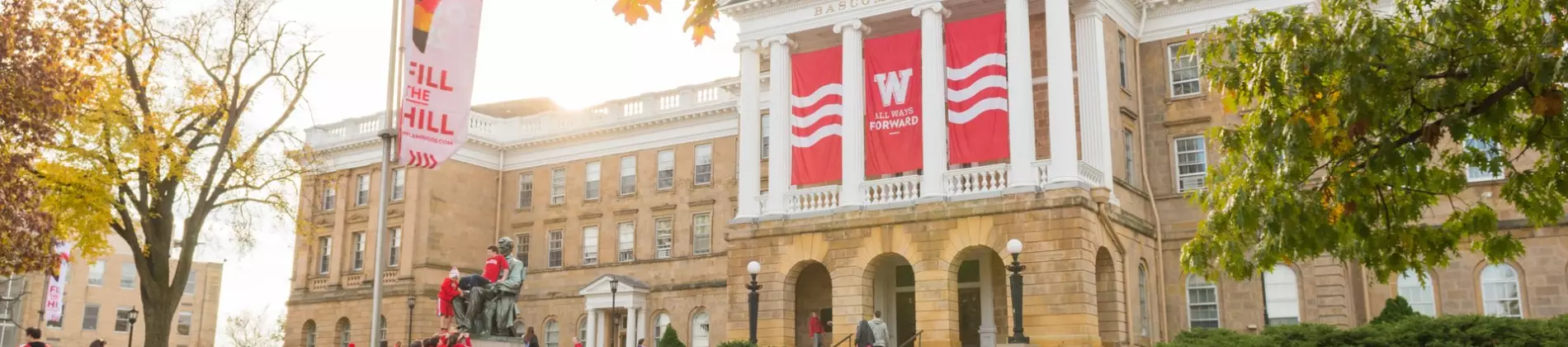
Zoology, B.A. at University of Wisconsin Madison

    Zoology, B.A. at University of Wisconsin Madison

    Zoology, B.A. at University of Wisconsin Madison

    The Zoology, B.A. at University of Wisconsin Madison is a Full Time Bachelor program offered at the university's main campus in Madison , United States of America. The program is delivered on campus in English and can be completed in 4 years. Students develop academic knowledge and practical skills that prepare them for future careers in this field. The next available intake starts on September 7, 2027.

    About Zoology, B.A.

    The zoology major is a gateway to the diverse areas of modern biology. The major can be tailored to prepare students for advanced study and careers in many different areas: health professions and public health; law; life sciences research in university, government, and industrial settings; education including museum, nature center, secondary school, and college teaching; biotechnology; and environmental studies.

    Specialized preparation is offered in ecology, systematics, limnology, morphology, molecular biology, cellular biology, developmental biology, genetics, neurobiology, physiology, evolution, and behavior. Several possible areas, emphasizing different interests, are outlined in the requirements tab. They include ecology, evolution, and behavior; anatomy, physiology, and organismal biology; and cellular, molecular, and developmental biology. The department encourages undergraduate participation in research and offers summer research scholarships to outstanding students.

    Goals of the Zoology Major

    The zoology major emphasizes critical thinking and conceptual skills that come from an understanding of how scientific information is obtained and evaluated, and of how this information can be applied to societal issues. The major provides a solid foundation in genetic, cellular, physiological, ecological, and evolutionary principles, and in the related disciplines of chemistry, physics, and mathematics. As a result, the major fosters an understanding of biological complexity including the interrelationships among humans and natural systems.

    The unique characteristics of the zoology major include:

    • broad-based, yet integrated training in wide-ranging areas of biology;
    • solid foundation of basic principles and processes in biology;
    • flexibility and advising needed to allow students to tailor the major to their specific goals;
    • wide range of opportunities for undergraduate involvement in independent research and senior thesis.

    1. Define and explain basic principles in biological sciences and major concepts in wildlife ecology including, population ecology, organismal biology, plant ecology/taxonomy, and genetics/evolution.
    2. Explain and discuss principles of wildlife management including natural resource legislation, policy, and applications.
    3. Explain and apply the scientific methods including designing and conducting experiments and testing hypotheses.
    4. Explain and demonstrate techniques for collection of data in laboratory and field settings, keep accurate records, and analyze data to address hypotheses.
    5. Demonstrate a style appropriate for communicating scientific results in written and oral form. Provide opportunity to develop these communication skills.

    Requirements and Admission Criteria for Zoology, B.A. at University of Wisconsin Madison

    Entry Requirements

    All undergraduate students at UW–Madison must complete the university-wide General Education Requirements, which are designed to convey the essential core of an undergraduate education. This core establishes a foundation for living a productive life, being a citizen of the world, appreciating aesthetic values, and engaging in lifelong learning in a continually changing world. These requirements provide for breadth across the humanities and arts, social studies, and natural sciences; competence in communication, critical thinking, and analytical skills necessary for success in college and beyond; and investigation of the issues raised by living in a culturally diverse society. This core is intended to provide students with intellectual and practical skills, basic knowledge of human cultures and the physical world, strategies for understanding these topics, and tools intended to contribute to their sense of personal and social responsibility. General Education complements the work students do in their majors and degrees. Together, these requirements help students learn what they need to know not just for making a living, but also for making a life.

    Completing the General Education Requirements is an important part of achieving these competencies, and to do so, students choose from many courses in communication, ethnic studies, quantitative reasoning, and breadth of study across disciplines in the natural sciences, humanities, literature, and arts, and social and behavioral sciences.

    Completing the General Education Requirements is an important part of achieving these competencies, and to do so, students choose from many courses in communication, ethnic studies, quantitative reasoning, and breadth of study across disciplines in the natural sciences, humanities, literature, and arts, and social and behavioral sciences.

    Each school and college may choose to allow General Education courses to count toward other degree and/or major requirements. Students should always check with their advisors to discuss any additional degree requirements and determine if students are required to take specific General Education courses or to complete the requirements in a particular order. Students should review their Degree Audit (DARS) report to see how they are progressing toward fulfilling the General Education requirements. Please refer to.

    English Requirements

    • IELTSMin 6.5
    • TOEFLMin 80

    English Program Requirements

    Freshman applicants educated in non-English speaking countries must submit an official TOEFL, IELTS, or Duolingo English Test (DET) score, unless English was the primary language of instruction in all four years of secondary school.

    All English proficiency exams should be sent electronically, directly from the testing service.

    We do not superscore any English Proficiency exam and score reports cannot be older than two years from the time you apply.

    How to Send Official Test Scores

    Duolingo English Test (DET)

    • Minimum accepted score: 105+
    • When submitting your score(s): Search category should be “Undergraduate,” then select “University of Wisconsin–Madison”
    • Please do not send to offices listed under “Other,” as we are unable to retrieve those scores
    • The DET should be sent with sub-scores

    IELTS

    • Minimum accepted score: 6.5+
    • When submitting your score(s): IELTS does not require a code, so please select our account name, “University of Wisconsin, Madison Undergraduate”
    • Please do not send paper copies of your IELTS scores
    • We do accept the IELTS Indicator

    TOEFL iBT:

    • Minimum accepted score: 80+
    • When submitting your score(s): TOEFL test code is 1846
    • We do not accept “MyBest” score from TOEFL nor any English Proficiency exam
    • For each TOEFL you submit, we will require the full score report
    • We do not accept the TOEFL iTP Plus for China, but we will accept the iBT Special Home Edition

    If you feel that you qualify for an English Proficiency Exam waiver based upon the requirements above, please submit all required transcripts to our office. Other test scores such as ACT, SAT, or AP (Advanced Placement) scores do not meet the requirements for a waiver. Once your transcripts are received in our office (are no longer displayed on your to-do list in your Student Center), we will determine your waiver eligibility. Waivers will not be processed prior to receipt of both the admissions application and transcripts.

    Career Opportunities after Completing Zoology, B.A.

    Undergraduate Advising in Wildlife Ecology

    All undergraduate students are assigned to an advisor when they declare the major. Students in the wildlife ecology major are required to meet with their advisor before they can enroll for the upcoming term. Undergraduate students are assigned to a faculty advisor and Allee Hochmuth, the Student Services Coordinator. If you have questions about advising or declaring the major, please contact Allee Hochmuth at [email protected].

    For more information about the wildlife ecology B.S. or the department in general, please contact Dr. Anna Pidgeon ([email protected]).

    Careers and Professional Development

    For more information on careers available to forest and wildlife ecology students please visit our Internship & Job Resources page. For more information on other academic, co-curricular, financial aid, and career opportunities and services available to forest and wildlife ecology students, please visit the CALS Career Services page. Students in the major are welcome to make an individual appointment with their advisor to discuss a number of career-related topics such as career exploration, search strategies, graduate school, and review of application materials (resume, CV, letters, etc.).

    Tuition and Fee Information for Zoology, B.A. at University of Wisconsin Madison

    Application Fee 60

    How to Apply for Zoology, B.A. at University of Wisconsin Madison

    Every year, we are fortunate to receive thousands of applications from a diverse range of students who are incredibly bright, engaged, and passionate. They have challenged themselves and those around them to make a difference in the world. They know that the University of Wisconsin–Madison is their next step toward something extraordinary—a place where they can lead, make discoveries, tackle key issues, gain knowledge, and establish lifelong friendships.

    Starting on August 1 every year, you can begin applying to the University of Wisconsin–Madison.

    The following deadlines pertain to both domestic and international applicants.

    Applications and all required application materials must arrive in our office by 11:59 p.m. Pacific time on the noted deadline dates.

    We cannot begin to review your application until all required materials are received.

    We strongly recommend that you apply with an email that is not affiliated with your high school and that you check often. This will ensure that you have continued access to your email account after graduation from high school.

    You can apply using either the Common Application or the UW System Application.

    Zoology, B.A. at University of Wisconsin Madison
    University of Wisconsin Madison
    University of Wisconsin Madison
    United States of America

    United States of America, Madison

    WhatsApp student consultation with YouApply