

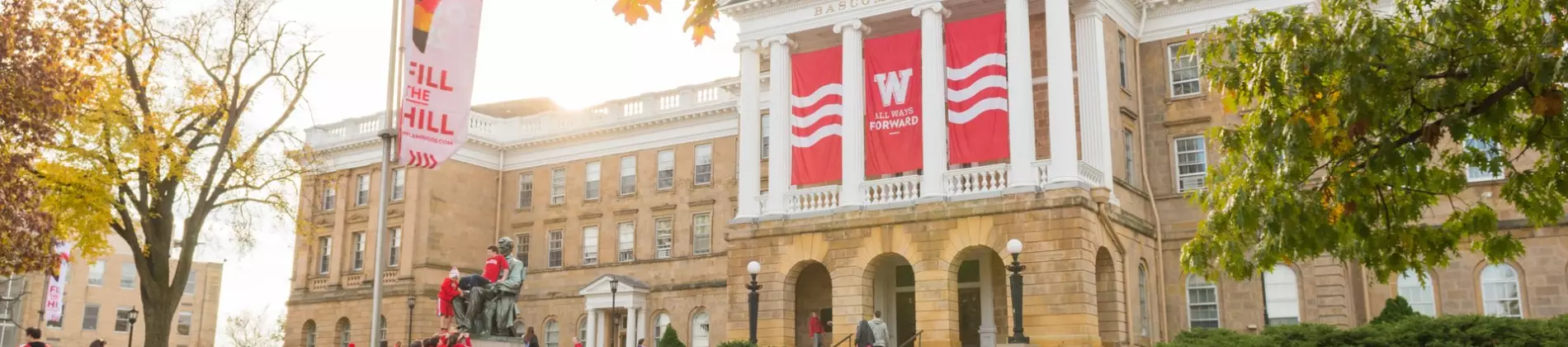


The Department of Communication Arts at the University of Wisconsin in Madison has long been one of the world's leading centers for study and research in communication. It was the first department in the United States to award a Ph.D. degree in the field, and its graduates serve on the faculties of leading universities, in research institutions, and in public and private agencies throughout this country and abroad.
The graduate programs in communication arts are designed to educate research scholars. Through intensive coursework within the department and in other departments, and through close professional association with appropriate faculty, graduate students in communication arts gain proficiency and sophistication in their chosen areas of study. Their attainment of doctoral degrees signifies their readiness to work as independent scholars in their areas and to make original contributions to human knowledge.
Communication Arts offers four distinct areas of graduate study:
COMMUNICATION SCIENCE1
Communication science is concerned with how people interact with one another in various means, modes, and contexts. It involves social scientific exploration utilizing both quantitative and qualitative methods. Reflecting the multi-faceted nature of the subject matter and a cross-disciplinary orientation of the field, students in communication science typically complete course work both in the department and in other social science fields. Graduate study in communication science is flexible and tailored to the individual. With a low faculty-to-student ratio and close collaboration with related academic units on campus, students have high access to faculty and with it, opportunities to work closely with faculty on research and broaden their horizon. Students are expected to develop fluency in at least two of the following areas:
- Social influencethat focuses interpersonal interactions, both online and offline, as well as group and organizational dynamics. It examines information exchange, persuasion, and other influence processes in various social contexts.
- Computer-mediated communicationthat examines individuals' uses of the media with digital, interactive, and networking features, as well as the effects of such usage on self, relationships, group dynamics, and other social processes.
- Human development and communicationthat addresses communication in relation to life cycle, focusing in particular on life cycle patterns in the means and modes of communication, as well as the effects of communicative engagement and media usage of youths and aging.
- Political communicationthat focuses on patterns and effects of communication, both face-to-face and mediated, on the democratic process. In particular it concerns how communication shapes the public sphere, how public deliberation over political issues takes place, and how the media may be related to civic and political engagement.
FILM1
The study of film concentrates primarily on motion picture history, theory, and criticism, approached through intensive critical analysis of individual films; research into the primary documents of filmmakers and the film industry; and the construction of theoretical models of film forms and styles, national cinemas, film genres, and the economics of the film industry. The program believes in the connection between film studies and film practice. Courses in film production enhance our understanding of motion picture history, theory, and criticism by revealing the practical decisions filmmakers confront. The program is not designed for students whose sole interest is in film production.
MEDIA AND CULTURAL STUDIES1
The media and cultural studies (MCS) program emphasizes the study of media in their historical, economic, social, and political context. MCS courses examine the cultural forms created and disseminated by media industries and the ways in which they resonate in everyday life, on the individual, national, and global level. Focusing primarily on sound and screen mediatelevision, new media, film, popular music, radio, video gamesbut reaching out across boundaries, MCS encourages interdisciplinary and transmedia research. MCS courses draw on a broad range of cultural theories spanning a spectrum of concerns all centrally relevant to the functioning of sound and screen media in a diverse and globalizing cultural environment.
RHETORIC, POLITICS, AND CULTURE1
Whether speaking from the podium or chatting on Facebook, people use discourse to craft identities, enact social change, and form a shared sense of community. Seeking to better understand this social force, the study of discourse explores significant themes, trajectories, and transformations in politics and society while considering particular individuals and groups, cultures, eras, genres, and topics. Courses in this area explore issues of power, digital media, citizenship, gender, sexuality, race, ethnicity, globalization, religion, inclusion and exclusion, social status, and marginalization.
Graduate work in rhetoric focuses on three interrelated areas: discourse, theory, and method. All three areas of study in rhetoric, politics, and culture are united by a common commitment to understanding the role of discourse in society as we act together to engage in culture and politics. Students are encouraged to investigate a wide range of discursive phenomena as they develop expertise that will empower them to conduct significant research and to take an active role in scholarly communities.
| 1 | These tracks are internal to the program and represent different pathways a student can follow to earn this degree. Applicants choose their area of study when applying to the program; however, the specific area of study will not appear on the transcript. |