

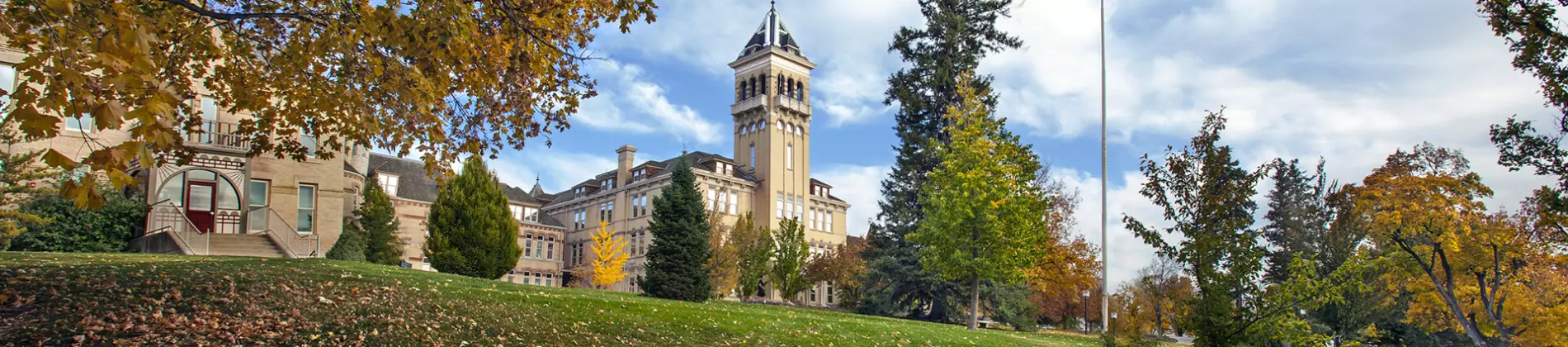


The Geosciences Department is one of the oldest departments at Utah State. It fosters a small environment where students are able to interact with faculty and receive specialized attention in their research.
7 specializations are available:
- Geomorphology and Earth Surface Processes: The geomorphology and earth surface processes specialization prepares students for careers in research, environmental monitoring, land management and restoration. Training emphasizes the fluvial and hillslope processes that shape landscapes across spatial and temporal scales.
- Geophysics: Research in geophysics includes geodetic measurement and modeling of rifting, orogeny, slow fault slip events, earthquakes and post-seismic deformation; inversion and imaging of subsurface properties using combinations of seismic, gravity, elevation and heat flow data; and regional- to continental-scale mapping of lithospheric strength and rheological properties.
- Hydrogeology: Research activity in hydrogeology includes wellhead protection in confined to semiconfined aquifers, the relationships between stream losses and water table depths, and the identification and geochemical characterization of groundwater recharge to surface streams.
- Petrology and Geochemistry: The petrology and geochemistry specialization focuses on the evolution of magmatic systems, oceanic lithosphere, collisional orogens, and convergent margin systems. These efforts utilize field relations, phase chemistry, and whole rock geochemistry to explore the relationship of these systems to the tectonic and geochemical evolution of the Earth.
- Sedimentology and Paleoecology: Research in sedimentology and paleoecology includes the sequence stratigraphy of Paleozoic mixed carbonate-siliciclastic systems and Proterozoic basin analysis, isotope geochemistry, and paleobiology.
- Structure and Tectonics: The specialization in structural geology and tectonics focuses on examining the mechanical and chemical evolution of fault zones using thermochronology and other approaches; the development of extensional structures in the Great Basin; fold-and-thrust structures in the Rocky Mountains; and the characterization of fluid-flow properties in fractured rocks.
- Climate Adaptation Science: The cross-disciplinary Climate Adaptation Science specialization provides students with experiences in actionable science through internships with agency, NGO, and industry partners and research experiences to identify adaptive responses to changing climate extremes. In a first internship, students contribute to projects and learn the workplace cultures and science needs of the host, which then inform the graduate research of student teams. In a second internship, students share science results and tools with the host organization and help put that science into action.
PhD options:
In addition to the 7 research specializations, there are two program tracks for the PhD:
- Academic track: This is designed to prepare graduates for a career in academia or other teaching-related settings; it includes both coursework in education and classroom teaching experience under the supervision of a faculty teaching mentor.
- Professional track: This is designed to prepare graduates for work in professional careers with the petroleum industry, other extractive industries, or environmental and hydrologic consulting. It includes coursework in statistics, information systems, remote sensing, and GIS, and completion of a professional internship is encouraged.