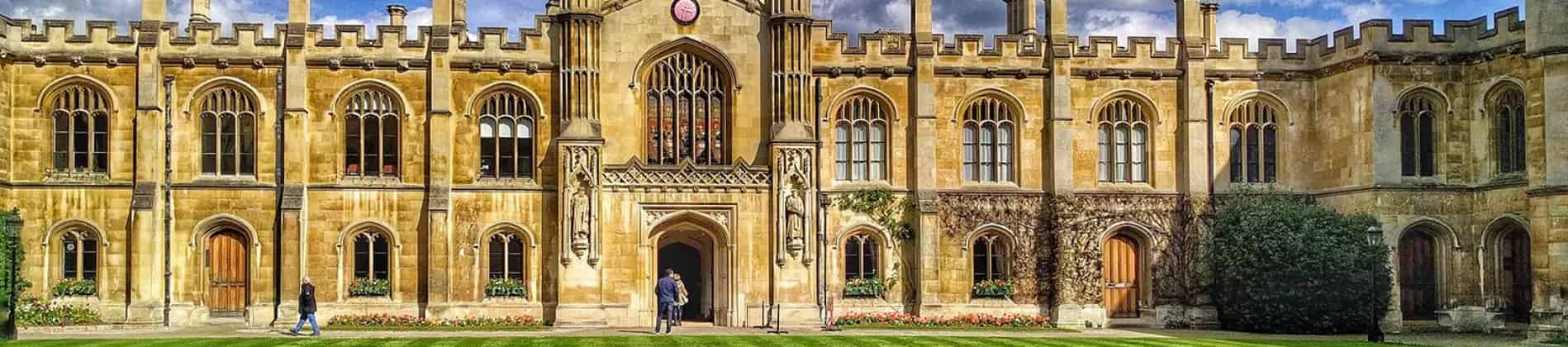


Medicine graduate course at Cambridge
This course combines core medical science with clinical medicine.
You’ll have the opportunity to develop your clinical skills through direct patient contact in hospital and community environments throughout the East of England.
This is an intense course, so you won’t have the time to do an additional degree, undertake optional study or exchange programmes at the same time.
The University departments collaborate with:
- the 4 Cambridge Colleges that offer the course
- 6 general practices in West Suffolk, and the West Suffolk Hospital in Bury St Edmunds, which is the main clinical base for the course
This course is for you if:
- it’s your second undergraduate degree
- you’re a home fee status student
If you don’t already have another undergraduate degree or you’re an international fee status student, you can:
- apply to study our standard Medicine course, which is open to everyone
If you successfully complete this course, you’ll graduate with Bachelor of Medicine as well as Bachelor of Surgery MB, BChir.
Teaching and facilities
Teaching
Clinical teaching is delivered on the wards and in general practice. There are also additional opportunities to attend general and specialist outpatient clinics.
The course is based in Cambridge. Some of the course is also delivered in regional hospitals or practices, to take advantage of the different educational opportunities they offer.
Facilities
This Cambridge Medical course features teaching from world experts, progressive technology and modern facilities.
You'll also have access to the impressive Cambridge University Library, one of the world’s oldest university libraries.
Course costs
When you go to university, you’ll need to consider two main costs – your tuition fees and your living costs (sometimes referred to as maintenance costs).
Your living costs will include costs related to your studies that are not covered by your tuition fees. There are some general study costs that will apply for all students – you can find details of these costs here.
Other additional course costs for Graduate Medicine are detailed below. If you have any queries about the costs, please contact the School of Clinical Medicine.
Equipment
To buy and maintain essential equipment for the course, the estimated cost is £60. Equipment includes:
- University approved scientific calculator
- Lab coat
- Safety glasses
- Dissecting instruments
- Gloves
You will also need:
- Theatre clogs – estimated contribution £10
- Stethoscope – estimated cost £60 to £100
Clinical Placements
Clinical placements take place in all 4 years of the course and will vary from student to student. You will be on placement at hospitals across the East Anglia Region.
The types of cost you will be expected to cover and those covered by the School of Clinical Medicine are detailed below.
- The School will pay the cost of one return journey for each clinical placement.
- Costs of accommodation near the clinical placement hospitals are covered by the School.
- You are expected to cover basic subsistence costs during your placements.
College accommodation
In the first 2 years of the course, you’ll need some College accommodation outside term time. The cost of this will vary by College, but should be around £130 per week. Around 9 weeks of additional accommodation will be needed across the first 2 years of the course.
Optional study abroad
There is an opportunity to go abroad for 7 weeks. If you do, the estimated cost is around £3,000. College and national grants may be available to help you cover these costs.
Course funding
You may be able to get funding from the NHS to help pay for your studies. Find out more about the NHS Bursary.
You may also be able to get funding from the Cambridge Bursary Scheme. See the Cambridge Bursary Scheme website for details.
Disabled students
The University respects and adheres to the GMC's guidance on supporting disabled learners. You can view the guidance on the GMC's Welcomed and valued website.
In your first 3 years, your College and the Accessibility and Disability Resource Centre (ADRC) will arrange most of your support.
During your clinical studies, the School of Clinical Medicine can arrange support. The School has a Student Academic Support Lead. They are a member of academic staff and they facilitate learning for disabled students.
Becoming a doctor
As a graduate you’ll be able to get provisional registration with the General Medical Council (GMC). The GMC has certain expectations about attitudes, behaviour and performance of medical students.
Read about registering as a doctor on the General Medical Council website.
You can then go anywhere in the country to complete two years as a junior doctor. These are known as Foundation Years. At the end of these two years you can register with the GMC as a doctor.
Read about the foundation programme on the UK Foundation Programme website.
If you’re graduating from 2025 onwards, you’ll need to take the Medical Licensing Assessment (MLA).
This is a test introduced by the General Medical Council to test the core knowledge, skills and behaviours needed to practise safely in the UK.
Read about the medical licensing assessment on the General Medical Council website.
Your future career
We enable students to develop the excellent communication, clinical, interpersonal and professional skills required for good medical practice.
As a graduate you’ll be ready for a range of careers across:
- general practice
- medicine
- psychiatry
- other specialities
If you’re interested in an academic research career, our MB/PhD Programme leads to the MB, BChir and PhD degrees. Read about the MB/PhD on the School of Clinical Medicine website.