


King's College London

Here is all you need to know as an international student!
King's College London Photos

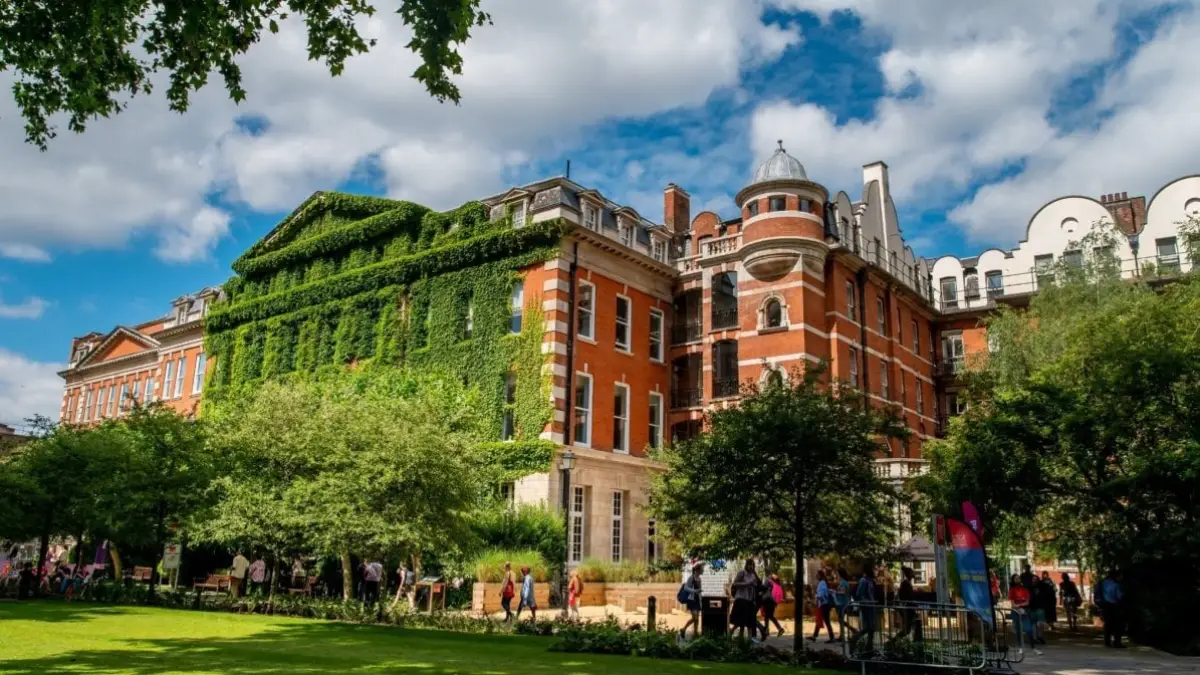



About King's College London
For an international student, King's offers direct access to London institutions, hospitals, cultural organisations, government, charities, technology companies, and professional networks. The trade-off is cost: London housing and transport require a larger budget than many other UK cities. Students should therefore choose King's for a specific course, academic environment, and career opportunity rather than for location or global ranking alone.
Where Is King's College London Located?
King's is not a single enclosed campus. It operates across central and south London, and the teaching location depends on the course. Strand Campus sits beside the River Thames near Covent Garden, Somerset House, and major legal and cultural institutions. Waterloo Campus is across the river. Guy's Campus is near London Bridge and Borough Market, while St Thomas' Campus is beside the hospital opposite the Houses of Parliament. Denmark Hill Campus is home to important health, psychiatry, neuroscience, and clinical activity.
This multi-campus model can be an advantage because students study close to relevant organisations and clinical partners. It also means they must check where most classes take place before choosing accommodation. A short distance on a map can still involve a busy or expensive commute. Walking, the London Underground, buses, and rail services are more practical than owning a car.
Programs and Academic Faculties
King's advertises more than 180 undergraduate courses. Some include study abroad, professional placements, clinical training, integrated master's study, language years, or joint subjects. The following examples show the university's range. Applicants must confirm the exact title, duration, accreditation, entry requirements, and availability on the official page for September 2027.
Faculty of Arts & Humanities in King's College London
- English BA
- History BA
- Liberal Arts BA
- Music BA
- Culture, Media & Creative Industries BA
The Dickson Poon School of Law in King's College London
- Law LLB
- Politics, Philosophy & Law LLB
- English Law & French Law LLB and Maîtrise en droit
- English Law & German Law LLB and MLLP or Certificate in Rechtswissenschaften
Florence Nightingale Faculty of Nursing, Midwifery & Palliative Care in King's College London
- Nursing with Registration as an Adult Nurse BSc
- Nursing with Registration as a Children's Nurse BSc
- Nursing with Registration as a Mental Health Nurse BSc
- Midwifery with Registration as a Midwife BSc
King's Business School in King's College London
- Business Management BSc
- International Management BSc
- Economics & Management BSc
- Accounting & Finance BSc
Faculty of Life Sciences & Medicine in King's College London
- Medicine MBBS
- Biomedical Science BSc
- Pharmacology BSc
- Neuroscience BSc
- Sport & Exercise Medical Sciences BSc
Institute of Psychiatry, Psychology & Neuroscience in King's College London
- Psychology BSc
- Neuroscience & Psychology BSc
Faculty of Natural, Mathematical & Engineering Sciences in King's College London
- Computer Science BSc
- Artificial Intelligence BSc
- Mathematics BSc
- Physics BSc
- Electronic Engineering BEng
- General Engineering BEng
Faculty of Dentistry, Oral & Craniofacial Sciences in King's College London
- Dentistry BDS
- Dental Therapy & Hygiene BSc
Faculty of Social Science & Public Policy in King's College London
- International Relations BA
- War Studies BA
- Politics BA
- Global Health & Social Medicine BA
- Geography BA
- Geography BSc
Top Programs at King's College London
This selection is based on academic visibility, professional relevance, research environment, accreditation, clinical or institutional links, and international student interest. It is not an official ranking issued by King's, and the best course depends on the student's preparation and intended career.
- Medicine MBBS: A five-year professional program that integrates medical science and clinical teaching. King's works with Guy's, King's College, and St Thomas' hospitals and more than 350 general practices. The degree is accredited by the General Medical Council.
- Dentistry BDS: A highly competitive clinical program connected to one of the university's strongest research areas and professional dental education.
- Law LLB: Offers legal study in central London near courts, firms, government, and policy institutions. Applicants should prepare for course-specific selection, including the LNAT where required.
- Computer Science BSc: Covers programming, software engineering, databases, artificial intelligence, logic, and computer systems. The degree is accredited by BCS, the Chartered Institute for IT.
- Psychology BSc: Benefits from King's large psychology, psychiatry, and neuroscience research environment and its links with clinical settings.
- International Relations BA: Suits students interested in diplomacy, policy, security, international organisations, and political analysis in a global city.
- War Studies BA: A distinctive King's subject combining history, politics, strategy, security, and the study of conflict.
- Business Management BSc: Gives students access to management study and London's broad financial, corporate, entrepreneurial, and public-sector environment.
King's College London Tuition Fees and Living Costs
Tuition Fees
International undergraduate fees at King's are course-specific. Clinical, laboratory, computing, business, law, humanities, and social science programs do not necessarily charge the same amount. At the time of this review, several official September 2027 course pages confirmed the intake and entry requirements but did not display a complete international fee figure in the accessible course information. Applicants should therefore use the official fees section, their offer, and the fee status decision for the exact amount rather than relying on a general estimate.
Ask whether the international fee is fixed or may increase in later years, especially for a three-, four-, five-, or six-year route. Add the immigration health surcharge, visa fee, flights, accommodation deposit, professional checks, equipment, travel to placements, and optional study-abroad or intercalated-year costs. Medicine, dentistry, nursing, and other clinical courses may also involve travel and placement expenses that are different from a classroom-based degree.
Monthly Living Costs
King's official living-cost guidance for 2026–27 estimates that a student should allow about £1,770 per month in addition to tuition. It gives a lower monthly range of £1,331 and a higher range of £2,342. Its average breakdown is £1,164 for accommodation, £167 for food, £173 for travel across Zones 1–4, and £266 for personal and leisure costs. These are planning figures, not guaranteed prices.
Actual housing can vary widely. For example, Angel Lane residence lists 2026–27 en suite rooms at £305 per week for 40- or 51-week contracts and studios at £441 per week for 51 weeks. A limited King's Affordable Accommodation Scheme rate of £163 per week is shown for eligible en suite rooms. Students must check eligibility, availability, contract length, included bills, and commute before comparing prices.
Is King's College London Worth the Cost?
King's can be worth the cost when the course has a strong academic or professional fit and the student can make real use of London. This may include clinical exposure, public-policy institutions, legal organisations, cultural partners, employers, research centres, and alumni networks. Its health partnerships, central locations, specialised faculties, and international community are clear advantages for the right student.
The value is less convincing if the student chooses only for the King's name, has no sustainable London budget, or can access a similarly accredited course elsewhere at much lower total cost. Before accepting an offer, compare every year's tuition, probable rent, transport, placement costs, professional recognition in the country of intended employment, and the evidence for graduate outcomes in the exact subject.
King's College London Scholarships
King's maintains a funding database for scholarships, bursaries, and other university-administered support. Awards vary by course, faculty, nationality, fee status, academic achievement, and financial circumstances. At the time of review, a single broad university-wide scholarship covering all international undergraduate applicants for 2027 could not be confirmed from the accessible official information.
Applicants should filter the King's funding database for international, undergraduate, prospective-student, and subject eligibility. Check the value, number of awards, closing date, whether a separate application is required, and whether funding continues after the first year. King's also operates hardship support for enrolled students, including an International Hardship Fund, but emergency hardship help is not a substitute for proving that the degree is affordable before enrolment. Do not include external government or private awards when evaluating university-administered scholarships.
Admission Requirements for International Students
Applications normally go through UCAS. Each course sets its own academic, subject, English-language, and selection requirements. Some programs require an admissions test, interview, portfolio, health or criminal-record checks, or relevant experience. Applicants should follow the September 2027 course page rather than copying requirements from another degree.
For example, Computer Science BSc lists A*A*A for 2027 entry and a three-year duration. Medicine MBBS lists A*AA, including grade A in Biology and Chemistry, and requires the UCAT. Its International Baccalaureate requirement is 38 points overall or 19 points from three Higher Level subjects, including grade 6 at Higher Level in Biology and Chemistry. Medicine starts in September 2027 and normally lasts five years, or six with an optional intercalated degree.
Law applicants should check the current LNAT requirement and test deadline. Clinical courses can have earlier UCAS deadlines and additional checks. English requirements are also grouped by course and may differ, so an IELTS score accepted for one program cannot be assumed for another.
Saudi applicants should confirm whether their school qualification qualifies for direct entry. Students whose national high-school diploma does not provide direct entry may need the King's International Foundation Programme or another accepted pathway. The university states that the Health, Life & Biosciences Foundation pathway can provide a route to apply for Medicine, subject to academic and English eligibility, taking the UCAT, and meeting the medicine selection rules. Progression is not automatic.
Muslim and Religious Life at King's
Prayer Facilities and Friday Prayer
King's provides dedicated Muslim prayer facilities for students and staff. Officially listed locations include the Hodgkin Building at Guy's Campus, the King's Building and Maughan Library at Strand, the Franklin-Wilkins Building at Waterloo, and rooms at Denmark Hill. Friday prayers are organised across the campuses, although access, capacity, and room details can change. Students should check the chaplaincy's current information at the start of term.
The students' union supports an Islamic society and other faith societies. London's large Muslim population also gives students access to mosques and community organisations across the city. Travel time depends on the campus and accommodation, so students with a regular mosque preference should include it in their housing decision.
Halal Food
Halal groceries, restaurants, and takeaway options are widely available across London, including areas near several King's campuses and residences. Campus catering arrangements and suppliers can change. Students who require certified halal meat or separate preparation should confirm current sourcing with the individual outlet. Self-catered accommodation may provide more control over ingredients and meal timing.
Where Should King's Students Live?
- King's residences: Useful for a supported first-year experience. Compare distance from the teaching campus, contract length, room type, bills, catering, and eligibility for affordable rooms.
- Stratford and Angel Lane: Can offer modern accommodation and direct transport, but the journey to central campuses must be budgeted in time and cost.
- Southwark and Bermondsey: Practical for Guy's, Waterloo, and parts of central London, though rents vary sharply by building and street.
- Waterloo, Lambeth, and Elephant & Castle: Convenient for Strand and Waterloo campuses, with busy transport links and generally high central-London prices.
- Denmark Hill and Camberwell: Often practical for health, psychiatry, psychology, and neuroscience students based in south London.
Before paying for a private room, verify the landlord or agent, deposit protection, bills, property condition, safety, commuting route, and exact contract period. Do not assume that a lower weekly price is cheaper if it requires a longer contract or expensive daily travel.
Your First Month at King's College London
Complete university registration and visa checks, collect your student card, activate digital systems, attend faculty induction, and learn the route between your accommodation and teaching buildings. Register with a doctor, arrange a UK bank account if needed, and understand local transport before the first major deadline.
Meet your personal tutor or academic adviser and locate the relevant library, student-services desk, prayer room, careers support, and wellbeing services. London creates many distractions and opportunities, so build a weekly budget and study timetable early. Clinical students should pay particular attention to placement instructions, occupational health, professional conduct, and travel planning.
Ramadan at King's College London
Ramadan may coincide with teaching, examinations, laboratories, clinical placements, or long daylight hours. King's has Muslim prayer spaces and an active faith community, but students should check each year's prayer and activity schedule. Plan suhoor, iftar, sleep, travel, study, and worship together rather than dealing with them separately.
If fasting affects a laboratory or clinical safety issue, speak with the appropriate academic or placement contact early and follow official procedures. Assessment arrangements are not automatically changed. Students with a medical concern should seek qualified health and religious guidance for their individual circumstances.
Working During and After Study
A UK Student visa may allow a degree-level student to work up to 20 hours per week during term time and full time during official vacations, but the individual visa conditions apply. Restrictions include self-employment and work as a professional sportsperson. Medicine, dentistry, nursing, and placement-heavy courses may leave little realistic time for the legal maximum. Part-time work should not be the main plan for paying London rent or tuition.
Eligible graduates may apply for the Graduate visa. Under the rules announced at the time of writing, the standard period is 2 years for applications made on or before 31 December 2026 and 18 months for applications made on or after 1 January 2027, with a longer period for doctoral graduates. A student beginning in 2027 should therefore plan on the later rule unless the government changes it again before graduation. Some careers also require professional registration or Skilled Worker sponsorship.
Three Weaknesses to Consider
- High total cost: King's estimates average living costs of £1,770 per month for 2026–27 before tuition. Housing can exceed that planning average.
- Dispersed campuses: The multi-campus model is academically useful but can complicate accommodation, society activities, library use, and commuting.
- Large and competitive environment: Popular programs attract strong applicants, and a large institution can feel impersonal unless the student actively uses tutorials, office hours, advising, and societies.
How King's College London Compares
| Factor | King's College London | What to Check |
|---|---|---|
| Location | Several central and south London campuses | Main teaching campus and commute |
| Academic range | More than 180 undergraduate courses across 9 faculties | Modules, accreditation, tests, and placements |
| Distinctive strengths | Health, law, psychology, international affairs, humanities, and policy | Subject-level evidence, not reputation alone |
| Living cost | Official average estimate of £1,770 per month for 2026–27 | Personal rent and transport budget |
| Student experience | Urban, international, professionally connected | Preference for a city network or enclosed campus |
Nearby Alternatives
University College London offers a very broad research portfolio and a large central-London community. The London School of Economics and Political Science is more specialised in social sciences. Queen Mary University of London offers a campus-based experience in east London with medicine, dentistry, law, and other subjects. City St George's, University of London may appeal to students seeking business, health, communication, or professional programs. Imperial College London is a specialist alternative for science, engineering, medicine, and business.
Who Is King's College London Best For?
King's is well suited to an independent student who wants a research-intensive university embedded in London and who will use the city's hospitals, institutions, employers, and cultural resources. It is especially relevant to students interested in health, dentistry, nursing, psychology, law, international affairs, public policy, humanities, computer science, or business.
It may be less suitable for someone who wants a quiet, self-contained campus, low living costs, very small classes throughout the degree, or housing within walking distance of every university activity. Students who need close individual support should investigate the specific faculty's teaching and advising arrangements.
Questions to Ask Before Looking at Rankings
- Which campus will host most of my teaching, and what will the commute cost?
- Does the course have the modules, accreditation, placement, and professional recognition I need?
- Can my family fund tuition and London living costs for every year without uncertain employment income?
- Do I meet the subject, English, test, interview, portfolio, and deadline requirements?
- How competitive are placement, study-abroad, intercalated, or optional pathways?
- Would another university provide a similar course with lower total cost or a better learning environment for me?
King's College London Rankings
Rankings measure different combinations of academic reputation, employer opinion, research, citations, international activity, teaching environment, and institutional resources. They do not directly measure whether one course, campus, budget, or teaching style suits a specific student.
QS World University Rankings
King's College London is ranked 37th in the QS World University Rankings 2027. QS includes measures such as academic and employer reputation, citations, faculty-student indicators, internationalisation, sustainability, and international research networks. Applicants should also examine course-level information and professional accreditation.
Times Higher Education World University Rankings
King's is ranked 38th in the Times Higher Education World University Rankings 2026 and sixth in the United Kingdom in that table. THE evaluates teaching, research environment, research quality, international outlook, and industry. Its result differs from QS because the indicators and weights are different.
Academic Ranking of World Universities
King's is ranked 67th in the 2026 Academic Ranking of World Universities. ARWU is strongly research-focused, using indicators connected to major awards, highly cited researchers, influential publications, indexed research, and per-capita performance. It is less informative about student support, daily teaching, housing, or local employability.
Universities Similar to King's College London
- University College London: Large, research-intensive central-London university with a broad subject portfolio.
- University of Edinburgh: Historic urban university with strong medicine, humanities, social sciences, and research.
- University of Manchester: Large Russell Group university in a major city with broad courses and lower living costs than central London in many cases.
- University of Bristol: Research-intensive university with strengths across health, law, science, engineering, and social sciences.
- University of Birmingham: Broad Russell Group alternative with a more self-contained campus and major teaching hospitals.
Frequently Asked Questions
Is King's College London a Russell Group university?
Yes. King's is a member of the Russell Group of research-intensive UK universities. Membership describes the institution's research profile, not whether every program is the right choice for every student.
How much does living in London cost?
King's estimates an average of £1,770 per month for 2026–27, excluding tuition. It gives a lower estimate of £1,331 and a higher estimate of £2,342, depending on housing and lifestyle.
How much is international tuition?
International tuition is course-specific. Applicants should use the official fee information and offer for September 2027 because health, laboratory, business, law, and humanities courses can charge different amounts.
Does King's offer student accommodation?
Yes. King's advertises several residences with different locations, room types, prices, and contract lengths. Availability and affordable-room eligibility must be checked for the intended intake.
Are Muslim prayer facilities available?
Yes. King's officially lists dedicated Muslim prayer rooms at Guy's, Strand, Waterloo, and Denmark Hill, with Friday prayer arrangements across several campuses.
Can international students work while studying?
Many degree-level Student visa holders can work up to 20 hours per week during term time, subject to the exact visa conditions and UK restrictions. Course attendance and placements take priority.
Does Medicine require the UCAT?
Yes. The 2027 Medicine MBBS requirements state that applicants must take the UCAT. Academic and subject requirements, deadlines, and selection details must also be met.
Should I choose King's because of its ranking?
No. Use rankings as secondary context after comparing course content, accreditation, campus, total cost, entry requirements, support, and career evidence.
Information for Parents
Parents should prepare a full multi-year budget covering tuition, rent, transport, deposits, visa charges, the immigration health surcharge, flights, equipment, placement travel, and emergencies. Currency movement can materially change the cost. Check the official offer and professional recognition in the country where the student may work.
Discuss accommodation security, late travel, healthcare registration, communication, and budgeting before departure. UK privacy rules mean the student normally needs to contact the university personally. Encourage them to learn how to use academic advising, wellbeing, disability, careers, international-student, chaplaincy, and money-advice services independently.
How YouApply Can Help
YouApply can help students compare appropriate universities, organise documents, understand course-specific requirements, and follow the steps from shortlist to enrolment. Final decisions on admission, fees, scholarships, visas, and professional recognition always come from the university or responsible authority, so each application must be checked against current official information.
Apply Now
1. Choose the Exact Course
Compare modules, campus, duration, accreditation, placement or study-abroad options, professional recognition, and the fee for September 2027.
2. Check Your Eligibility
Match your grades, required subjects, English evidence, qualification, and any UCAT, LNAT, interview, portfolio, experience, or early-deadline requirement.
3. Prepare the Application
Gather academic records, certified translations where required, reference information, English results, and the evidence requested through UCAS. Submit before the applicable deadline.
4. Confirm Funding and the Visa Plan
Verify tuition, scholarship conditions, London living costs, deposit dates, and acceptable financial evidence. After meeting the university's conditions, follow the current Student visa process.
5. Arrange Housing and Arrival
Select accommodation based on the teaching campus and budget, review the contract, plan travel, complete pre-arrival tasks, and attend registration and faculty induction.

Need help applying to King's College London in United Kingdom?
YouApply academic advisors help international students compare programs, understand admission requirements, prepare university applications, and plan student life in United Kingdom. Our academic consultation service is completely free for students.
King's College London FAQs
King's College London Ranking




Top Programs at King's College London
Explore undergraduate and postgraduate programs at King's College London.
- Accounting & Finance BSc
- Anatomy, Developmental & Human Biology iBSc
- Anatomy, Developmental & Human Biology BSc
- Ancient History BA
- Artificial Intelligence MSci
- Artificial Intelligence BSc
- Artificial Intelligence with a Year in Industry BSc
- Biochemistry BSc
Scholarships at King's College London for International Students
Explore scholarships at King's College London including merit-based and need-based funding options.
- Harold Moody PGR Studentships 2023/24 at King's College London
- Higher Education Scholarships for Palestinians (HESPAL) at King's College London
- King's College London Marshall Scholarship at King's College London
- Joint PhD Scholarships 2023/24 at King's College London
- Inlaks Shivdasani Foundation at King's College London
- Fulbright Postgraduate Scholarship at King's College London
- King's Living Bursary 2022-23 at King's College London
- Care Experienced and Estranged Bursary 2022-23 at King's College London
- Departmental Scholarship - Sustainable artwork preservation at King's College London
- FUNED Credit-Scholarships at King's College London
Similar Universities to King's College London
Discover similar universities in the same country based on academic rankings and programs.