



University of Warwick

Here is all you need to know as an international student!
University of Warwick Photos




About University of Warwick
The university teaches through three faculties: Arts, Science, Engineering and Medicine, and Social Sciences, spread across around 41 academic departments. It is particularly well known internationally for Warwick Business School, Warwick Manufacturing Group (WMG), and its economics, law and mathematics departments, alongside a growing medical school. Today the university has more than 28,000 students, of whom roughly a third are international, drawn from around 250 countries.
For a student comparing UK universities, Warwick's identity sits between the older, more traditional institutions and newer, more vocationally driven universities. It behaves like a research-intensive, campus-based university, but with a strong applied and business-facing character through WBS and WMG. This combination matters when deciding whether Warwick fits a particular academic or career goal, rather than choosing it purely on reputation.
Where Is University of Warwick Located?
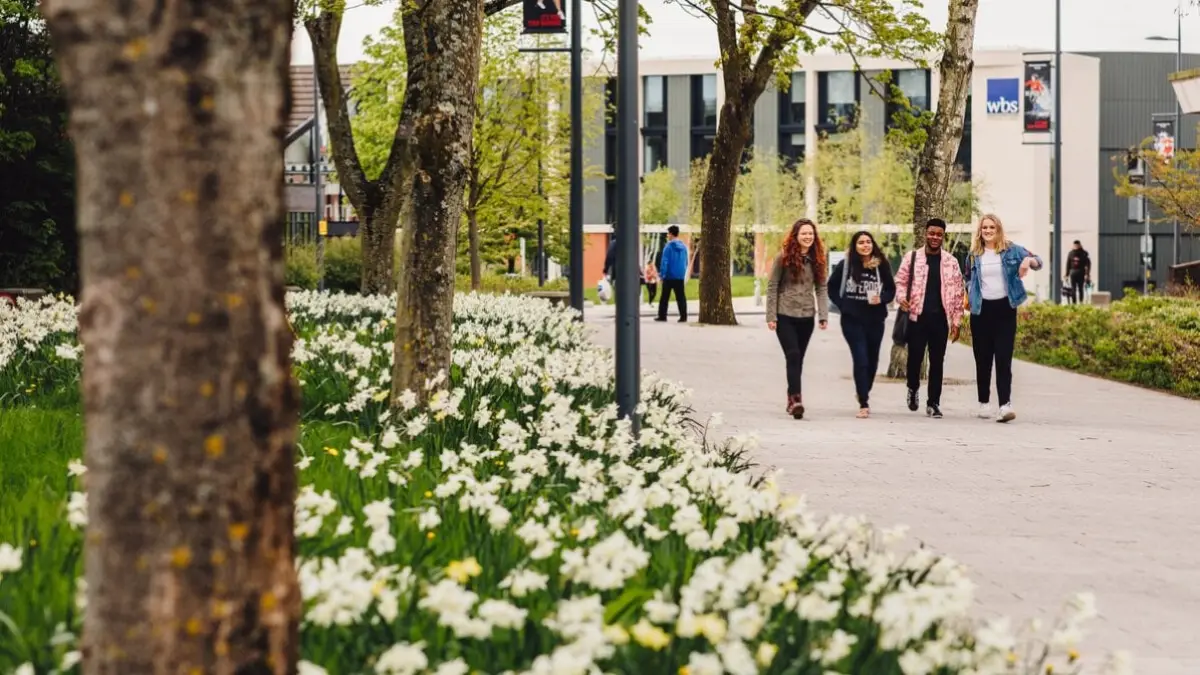
The university's main campus sits on the border of Coventry and Warwickshire, a few miles south of Coventry city centre, despite carrying the name of the nearby town of Warwick rather than the city it is closest to. It is a single, self-contained campus with teaching buildings, laboratories, libraries, sports facilities and student accommodation in one place, which suits students who prefer not to commute daily into a city centre.
Getting into central Coventry is straightforward but not instant. Direct bus services, including the frequent 12X route, connect the campus to the city centre and to Coventry railway station in around fifteen to thirty minutes depending on the stop and time of day. Students who want to live off campus in central Coventry should factor this commute into their daily routine, particularly for early classes or late library sessions.
Coventry itself is a mid-sized, relatively affordable English city compared with London or other major UK study destinations, though rents and general living costs still vary considerably by area and by whether a student lives in university-managed accommodation, a private house-share, or purpose-built private student housing near campus.
Programs at University of Warwick
Warwick organizes its academic offering through three faculties, and each covers a wide range of subject areas rather than a narrow specialism. The following selection focuses on the main undergraduate subject areas most relevant to prospective international students, grouped by faculty.
Faculty of Arts in University of Warwick
The Faculty of Arts covers language, literature, history and creative subjects, taught through around fifteen departments and centres.
- English and Comparative Literary Studies
- History
- Classics and Ancient History
- Film and Television Studies
- Modern Languages and Cultures
- History of Art
- Theatre and Performance Studies
Faculty of Science, Engineering and Medicine in University of Warwick
This faculty brings together traditional sciences, engineering, computing and medicine, and includes Warwick Manufacturing Group and Warwick Medical School.
- Computer Science
- Mathematics
- Physics
- Chemistry
- Life Sciences
- Engineering
- Psychology
- Statistics
- Medicine (through Warwick Medical School, typically at graduate-entry level)
Faculty of Social Sciences in University of Warwick
The Social Sciences faculty is home to Warwick Business School and around fourteen departments and centres covering business, law, politics and society.
- Economics
- Law
- Politics and International Studies
- Sociology
- Philosophy
- Applied Linguistics
- Business (undergraduate and postgraduate degrees through Warwick Business School)
Top Programs at University of Warwick
Warwick does not publish an official internal ranking of its own programs, so the selection below is based on a combination of subject reputation, research strength, industry connections and consistent demand from international applicants, rather than an official university ranking.
- Economics
- Law
- Mathematics
- Computer Science
- Business (Warwick Business School programs)
- Politics and International Studies
- Psychology
- Engineering
The real cost of studying at University of Warwick
Choosing Warwick is, in practical terms, a decision about a mid-to-high tuition cost UK research university combined with a moderately priced English city, rather than one of the most expensive London-based options.
Tuition fees for international students
For 2026/27, Warwick groups its overseas undergraduate tuition fees into bands by subject rather than charging a single flat rate. Humanities, languages, social science and law programs generally sit in a lower band, at around £27,870 per year. STEM subjects, engineering, business and management programs sit in a higher band, at around £35,530 per year. Medicine has its own separate fee structure, with a lower fee in the first year (around £32,510) rising substantially from the second year onward (around £56,660 per year) once clinical training begins.
These figures apply to the 2026/27 intake and are stated by the university to be subject to an inflationary increase in future years for continuing students. Exact fees vary by specific course and, for postgraduate study, by program, so applicants should confirm the exact figure for their intended course and intake year directly through the university's official fee pages rather than relying on a single average number.
Monthly living costs
Warwick does not publish a single official "monthly living cost" figure that applies to every student, because this depends heavily on accommodation choice, lifestyle and whether a student lives on campus or in the city. In broad terms, a student's monthly budget in the Coventry area needs to account for rent (on-campus or private), food, transport (particularly the bus fare into Coventry if living off campus), mobile and internet costs, and any additional costs tied to a specific course, such as fieldwork, lab coats or specialist equipment. Students should use the university's official living costs guidance, alongside their own accommodation offer, to build a realistic personal budget rather than relying on generic averages from third-party websites.
Is University of Warwick worth the cost?
Whether Warwick is worth its tuition fee depends heavily on the subject and the student's own goals. For subjects where Warwick has a particularly strong reputation and dense industry links, such as economics, business, law and mathematics, the combination of academic quality, research environment and career networks can justify a fee that sits above the lowest end of the UK market.
For students whose main priority is living in a specific major city, such as London, rather than a campus near a mid-sized city, Warwick's out-of-town campus model may feel like a trade-off rather than an advantage, even though it offers a self-contained, safe and well-resourced environment. Prospective students should weigh Warwick against other UK universities with similar rankings and fee levels, considering their own preferred subject strength, city preference and budget, rather than assuming that a top-ten UK ranking automatically makes it the right personal choice.
Scholarships at University of Warwick
Warwick directs international applicants to a central Scholarships and Bursaries portal, which brings together central university awards as well as scholarships linked to specific departments, UKRI-funded doctoral training centres, industry sponsors and charitable foundations. At the time of writing, the university's own pages do not set out detailed award amounts, eligibility criteria and deadlines for every individual scholarship in one place; instead, applicants are expected to search the interactive scholarship tool for opportunities relevant to their nationality, subject and study level.
Because specific award names, values and deadlines can change between admissions cycles, prospective students should check the official scholarship search tool directly for their intended course and intake, rather than relying on older or third-party summaries. Students with an external sponsor should also note that the university applies restrictions on certain categories of sponsor, such as those linked to tobacco or money-laundering risk.
Admission requirements at University of Warwick
Academic entry requirements vary by course and are published individually for each degree, so applicants should always check the specific course page rather than assuming a single university-wide standard applies.
English language requirements are organized into three bands (A, B and C), with higher-demand or more linguistically intensive courses requiring the higher bands. For IELTS Academic taken from 1 September 2024 onward, Band A requires an overall score of 6.0 with at least 5.5 in each component, Band B requires 6.5 overall with at least 6.0 in each component, and Band C requires 7.0 overall with at least 6.5 in each component. The IELTS "One Skill Retake" format is not accepted. TOEFL iBT and Pearson PTE Academic are also accepted, each with their own band-specific minimums, and test rules changed for tests taken from 21 January 2026 onward, so applicants should confirm which rules apply to their test date. English test results are generally valid for two years and one month before the course start date.
Applicants who do not yet meet the direct-entry English or academic requirements can consider Warwick's International Foundation Programme, which has its own separate English language entry requirements and prepares students for progression onto an undergraduate degree.
Cultural and religious life for Arab and Muslim students
The United Kingdom is a predominantly non-Muslim country, so this is a genuine adjustment for many students from Saudi Arabia and the GCC, even though Warwick itself has an active and well-established Muslim community.
Prayer and mosques
Warwick has invested directly in Muslim student life on campus: the university opened a dedicated Islamic prayer hall on campus, reported at the time as a quarter-of-a-million-pound facility, alongside an active Warwick Islamic Society run by students. Beyond the campus, Coventry itself has a wider Muslim community and mosques in the city that students can access using the bus routes connecting campus to the city centre. Students should confirm current opening hours and facilities directly with the Islamic Society, since student-run facilities and timetables can change year to year.
Halal food
Coventry has an established Muslim community, which generally supports the availability of halal food options in and around the city, though the university's own catering pages should be checked for which specific on-campus outlets currently offer halal choices, since catering arrangements can change between years. Many students who want tighter control over halal sourcing choose to cook at home using ingredients from halal grocers in Coventry rather than relying solely on campus catering.
Where do students usually live in the United Kingdom?
For Warwick specifically, the practical housing decision is less about choosing a UK-wide region and more about choosing between on-campus halls, private housing near campus, and housing in central Coventry.
On-campus accommodation
Warwick offers a range of on-campus residences with different contract lengths, from 35-week contracts covering term time and the Christmas break up to 50-week contracts covering the full year. On-campus living removes the need for a daily commute and gives full access to student services, but exact rents vary by residence type and contract length and should be checked on the university's own accommodation pages before budgeting.
Private housing near campus or in Coventry
Students who prefer more independence, or who arrive after on-campus places are allocated, often look at private shared housing either near the campus edge or further into Coventry. This usually costs less than the highest-specification on-campus options but adds a bus or cycle commute, and requires more independent handling of contracts, bills and deposits.
Your first month in Coventry: what should you expect?
The first weeks typically involve settling into accommodation, registering with a doctor (GP), opening a UK bank account, buying a local SIM card, and learning the bus routes between accommodation, campus and the city centre. New international students should expect a structured university orientation ("Welcome Week") covering academic registration, campus tours and social events designed to help them meet other students quickly.
Financially, the first month is often the most expensive because of deposits, initial shopping for a room, and setting up services, so new students benefit from arriving with a cushion beyond their expected monthly budget. Academically, UK seminar-style teaching, with a heavier expectation of independent reading and preparation than some students are used to, is often the biggest early adjustment, more so than the physical move itself.
Ramadan while studying
Because the UK is a predominantly non-Muslim country and Warwick's academic calendar does not adjust automatically for Ramadan, students observing the fast during term time should expect ordinary teaching, assessment and exam schedules to continue as normal. The active Warwick Islamic Society typically organizes community iftars and related events during Ramadan, which can help offset the lack of a wider public rhythm around the month. Students with specific concerns about exam timing or workload during Ramadan should raise this early with their department rather than assuming an automatic accommodation will be made.
Working while studying and after graduation
International students on a UK Student visa are generally permitted to work part-time during term time, subject to the conditions on their visa and any course-specific restrictions, and can normally work full-time during official vacation periods; the exact permitted hours should always be checked against the student's own visa conditions rather than assumed.
After graduation, eligible students can currently apply for the UK's Graduate Route visa, which, as of 2026, grants two years of post-study work rights for bachelor's and master's graduates who apply on or before 31 December 2026, and three years for PhD graduates, provided they meet the eligibility conditions, including holding a valid Student visa and receiving confirmation of course completion from the university. Because immigration rules are reviewed periodically by the UK government, students should verify the current Graduate Route rules directly with official UK government sources close to their graduation date rather than relying on rules described at the time of application.
Warwick's own careers service supports students with employability resources and a dedicated section for international students navigating UK-specific job searching and visa considerations.
Three weaknesses you should know
Warwick's out-of-town campus, while safe and self-contained, means students who specifically want to live inside a major city day-to-day may find the location less appealing than a city-centre university, even though transport links to Coventry are reasonably frequent.
Tuition fees for STEM, engineering, business and medicine bands sit well above the lower humanities band, and the university's own guidance flags that fees may rise with inflation in later years of a course, which matters for multi-year financial planning.
Detailed scholarship information for international students is not consolidated in one page with fixed amounts and deadlines; students have to actively search the scholarship tool and may not find a guaranteed funding route for their specific situation.
Quick comparison with other universities
| University | QS World Ranking (2027) | City type | Notable strength |
|---|---|---|---|
| University of Warwick | 68th | Campus near mid-sized city (Coventry) | Business, economics, law, manufacturing (WMG) |
| University of Birmingham | Top 100 band (varies by year) | City-based, large UK city | Broad research strength, medicine |
| University of Nottingham | Top 100–150 band (varies by year) | City-based campus | Broad subject range, large international intake |
| University of Leeds | Top 100 band (varies by year) | City-based campus | Broad subject range, strong student life |
Exact positions shift slightly year to year across ranking tables, so students comparing these options closely should check the same ranking year and methodology for each university before drawing firm conclusions.
Considering other universities in Coventry?
Coventry University, a separate and distinct institution from University of Warwick, is also based in the city, closer to the city centre itself. Students who specifically want a city-centre campus experience rather than an out-of-town one sometimes compare the two, even though they differ in academic profile, research intensity and typical fee levels.
Who is University of Warwick for — and who is it not for?
Warwick tends to suit students who want a research-intensive UK university with particular strength in business, economics, law, mathematics and manufacturing-related engineering, and who are comfortable with a self-contained campus lifestyle rather than an inner-city one.
It may be less ideal for students whose priority is living inside a major city centre day-to-day, or for those seeking the very lowest tuition band available in the UK market, since several of Warwick's most in-demand subjects sit in its higher STEM and business fee bands.
Before rankings: ask yourself these questions
Can I comfortably afford the specific fee band for my intended subject, not just the university's average? Do I want a campus lifestyle outside a city, or a university based directly in a city centre? Are Warwick's particular strengths, such as business, economics or engineering, actually the subject I want to study, or am I choosing the university mainly for its overall ranking? Have I checked the specific English language band and academic requirements for my exact course, rather than a general university-wide requirement?
University of Warwick Ranking
QS World University Rankings 2027 for University of Warwick
Warwick ranks 68th globally and 10th in the UK in the QS World University Rankings 2027, among more than 1,500 institutions assessed across 106 countries.
The Times Higher Education World University Rankings 2026 for University of Warwick
Warwick is placed joint 122nd in the world in the Times Higher Education World University Rankings 2026.
The Academic Ranking of World Universities (ARWU) 2026 for University of Warwick
Warwick sits in the 101–150 band in the 2026 Academic Ranking of World Universities (Shanghai Ranking), which groups universities in bands rather than exact individual positions at this range.
Similar Universities to University of Warwick
The University of Birmingham is a reasonable comparison point as another large, research-intensive Midlands university with broad subject strength and a similarly international student body. The University of Nottingham and the University of Leeds are also frequently compared with Warwick by applicants weighing UK universities of a similar overall ranking tier, broad subject range, and reasonably sized international student communities, though each has its own distinct academic strengths and city setting that a student should compare individually rather than assuming close ranking numbers mean an identical experience.
Questions students ask often
Is University of Warwick suitable for Saudi and GCC students? Yes, in the sense that the university has an established Muslim student community, a dedicated Islamic prayer facility, and a genuinely international student body, though students should still expect a real cultural adjustment given that the UK is a predominantly non-Muslim country.
Is Coventry an expensive city? It is generally considered more affordable than London, though exact living costs still depend heavily on accommodation type and personal lifestyle, so students should build their own budget from official university guidance rather than a single average figure.
What English test score do I need? It depends on the course: requirements are grouped into three bands, with IELTS Academic requirements ranging from 6.0 to 7.0 overall depending on the band assigned to a specific course.
Is campus accommodation guaranteed? The university offers a range of on-campus residence options with different contract lengths, but students should check current eligibility and application timing directly with Warwick's accommodation service rather than assuming automatic placement.
Can I work while studying? Most international students on a Student visa can work part-time in term time and more hours during vacations, subject to their specific visa conditions.
What happens after I graduate? Eligible graduates can currently apply for the UK's Graduate Route visa, which as of 2026 offers two years of post-study work rights for bachelor's and master's graduates (under current rules applying to applications made on or before 31 December 2026) and three years for PhD graduates.
Does Warwick offer scholarships for international students? Yes, through a central scholarships portal that aggregates university, departmental, industry and externally funded awards, though students need to search this tool directly for the specific opportunities relevant to their course and nationality.
What is Warwick particularly known for? Warwick is especially recognized for Warwick Business School, Warwick Manufacturing Group, and strong research performance in economics, mathematics and related social sciences.
A message for parents
University of Warwick is a research-intensive, well-established UK university with a genuinely international student population and organized support structures, including an active Islamic Society and dedicated prayer facilities that can help a Muslim student settle in more comfortably than at a university with a smaller Muslim community. The self-contained campus model also means most day-to-day student life, from teaching to accommodation to social activities, happens within a single, controlled environment rather than scattered across an entire city.
Families should still budget realistically: tuition fees vary considerably between the humanities band and the STEM, business or medicine bands, and detailed scholarship support is not guaranteed or centrally listed with fixed amounts, so it is worth treating any scholarship as a possibility to actively pursue rather than a certainty to plan around. As with any UK university choice, verifying current visa, work-rights and fee rules close to the actual application date is more reliable than relying on rules described months or years earlier.
Need help applying to University of Warwick?
YouApply can help students and families compare University of Warwick against other UK and international options by bringing together information on programs, admission requirements, tuition fees, and general application steps in one place, making it easier to weigh Warwick against alternatives before committing to a specific application.
Apply Now! for University of Warwick
1. Choose a course
Start from the specific undergraduate or postgraduate course page rather than the university overview, since entry requirements, fee band and English language band are all set at the course level, not the university level.
2. Check your eligibility
Confirm both the academic entry requirement for the specific course and the English language band (A, B or C) that applies to it, checking whether your IELTS, TOEFL or PTE result was taken under the current or older rules, since requirements changed for tests taken from 21 January 2026 onward for TOEFL.
3. Gather your documents
Typical documents include a valid passport, academic transcripts and certificates, an accepted English test result, and, for some courses, a personal statement or portfolio. Exact document requirements vary by course, so the specific course page should be checked rather than assuming a single standard list applies to every program.
4. Check your finances
Budget for the correct tuition fee band for the specific course (humanities and social science band, STEM and business band, or the separate medicine fee structure), plus realistic living costs in the Coventry area, any visa-related financial requirements set by the UK government, and an initial cushion for setup costs in the first month.
5. Submit your application
Undergraduate applications to Warwick are made through the UK's centralized undergraduate admissions service, while postgraduate applications are generally made directly to the university through its own application system. Applicants should follow the specific application route stated on their intended course page.

Need help applying to University of Warwick in United Kingdom?
YouApply academic advisors help international students compare programs, understand admission requirements, prepare university applications, and plan student life in United Kingdom. Our academic consultation service is completely free for students.
University of Warwick FAQs
University of Warwick Ranking

Best Global Universities Rankings -2025-2026 for University of Warwick
University of Warwick ranking is #182 globally in the Best Global Universities Rankings -2025-2026.



Top Programs at University of Warwick
Explore undergraduate and postgraduate programs at University of Warwick.
- Accounting and Finance
- Accounting and Finance (with Foundation Year)
- Accounting and Finance with Placement Year
- Ancient History and Classical Archaeology
- Automotive Engineering BEng
- Biochemistry BSc
- Biochemistry with Placement Year BSc
- Biological Sciences BSc
Scholarships at University of Warwick for International Students
Explore scholarships at University of Warwick including merit-based and need-based funding options.
- English and Comparative Literary Studies Bursary at University of Warwick
- Warwick Chemistry Regional Coventry Scholarship at University of Warwick
- Chancellor's International Scholarships at University of Warwick
- China Scholarship Council at University of Warwick
- School of Modern Languages and Cultures Departmental MA Scholarship at University of Warwick
- School of Life Sciences Excellence Awards at University of Warwick
- MA TESOL Bursary at University of Warwick
- Bursaries for MSc in Intercultural Communication for Business and the Prof... at University of Warwick
- WMG West Midlands Leaders Scholarship at University of Warwick
- Department of Statistics MSc Bursary at University of Warwick
Similar Universities to University of Warwick
Discover similar universities in the same country based on academic rankings and programs.