


University of Birmingham in United Kingdom

Here is all you need to know as an international student!
University of Birmingham in United Kingdom Photos


About University of Birmingham in United Kingdom
Birmingham's academic and research reputation has grown dramatically in recent years. In the QS World University Rankings 2027, it achieved its highest global position in a decade, reflecting consistent investment in research quality, international partnerships, and student outcomes. Its alumni community spans some of the most remarkable figures in science, politics, business, and the arts, and it produces graduates who are consistently among the most sought after by employers worldwide.
For international students - particularly those from the Middle East, Gulf, and Arab world - Birmingham offers one of the most welcoming and culturally comfortable environments in the UK, with a large Muslim student community, extensive prayer facilities, and an abundance of halal food options both on and around campus.
Where Is the University of Birmingham Located?
Birmingham is England's second-largest city and one of Europe's most multicultural urban centres. Home to more than 1.1 million people, it sits in the West Midlands region of England, approximately 120 miles northwest of London. Birmingham is exceptionally well connected: from Birmingham New Street station, trains reach London Euston in as little as 85 minutes, and Birmingham International Airport provides direct flights to destinations across the Middle East, Europe, Asia, and North America.
The city itself has undergone remarkable transformation in recent decades, with a thriving food, arts, and cultural scene. Birmingham is famous for its diversity - it is one of the youngest major cities in Europe by population - and this creates a vibrant, cosmopolitan environment in which students from all over the world feel genuinely at home. The Bullring shopping district, Brindleyplace canal quarter, and extensive restaurant scene around Broad Street and the Balti Triangle (Birmingham's world-famous South Asian dining quarter) make it a city with something for everyone.
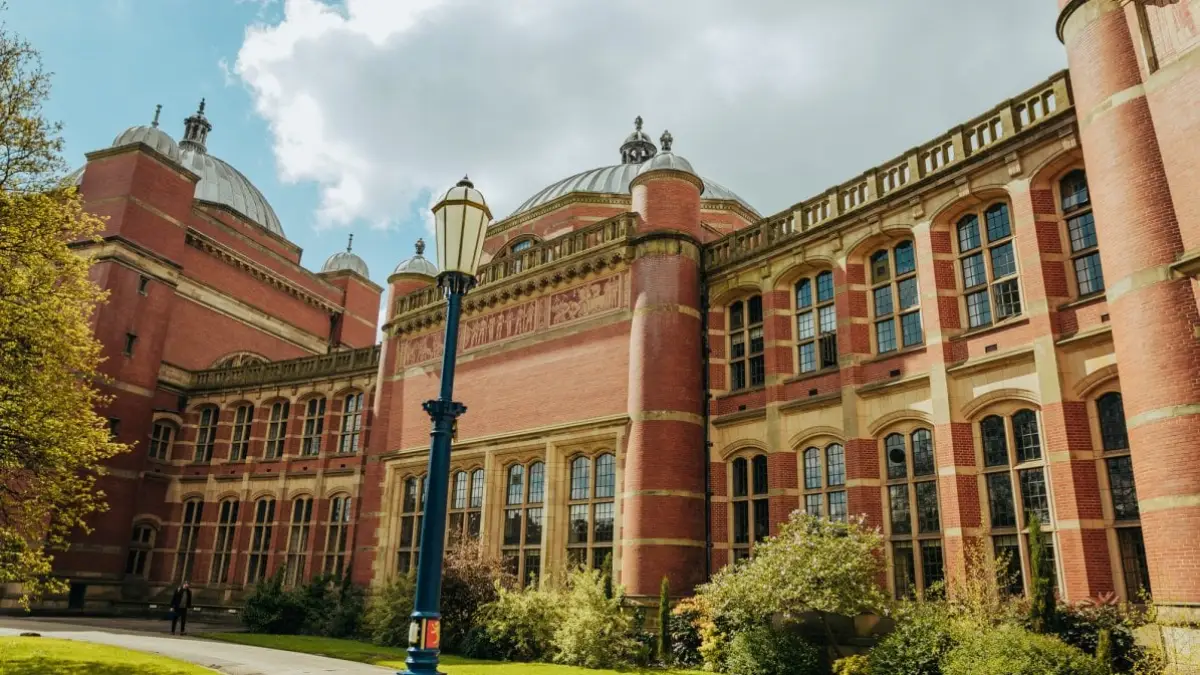
The Edgbaston campus itself is a 10-minute drive or 20-minute bus ride from the city centre, set in a leafy residential area with its own sports facilities, cafes, libraries, and student union. The campus feels self-contained and safe, while the city's energy and opportunities are always close at hand.
Programs and Colleges at the University of Birmingham
The University of Birmingham is currently organised into five academic colleges, covering the full breadth of academic disciplines.
College of Arts and Law
This college covers programs in History, English Literature, Modern Languages, Philosophy, Theology, Music, Drama, Classics, Art History, Law (via Birmingham Law School), and Creative Industries. It is home to one of the UK's most research-active humanities faculties, with particular strengths in theology, history of science, and English literature.
College of Engineering and Physical Sciences
Engineering and physical sciences at Birmingham span Chemical Engineering, Civil Engineering, Mechanical Engineering, Electronic and Electrical Engineering, Computer Science, Mathematics, Physics and Astronomy, and Materials Science. Birmingham's engineering programs are internationally recognised and supported by state-of-the-art laboratories and industry partnerships with companies such as Rolls-Royce, Jaguar Land Rover, and HSBC.
College of Life and Environmental Sciences
This college includes Biosciences, Geography, Earth and Environmental Sciences, Psychology, and Sport, Exercise and Rehabilitation Sciences. Psychology at Birmingham is one of the largest and strongest in the UK, and its environmental sciences programs reflect the university's deep commitment to sustainability research.
College of Medicine and Health
Birmingham Medical School, one of the UK's oldest and largest, sits within this college alongside Dentistry, Pharmacy, Nursing and Midwifery, Health Sciences, Physiotherapy, and Applied Health Sciences. Birmingham's medical and health programs benefit from close partnerships with major NHS Trusts in the region, including University Hospitals Birmingham, one of Europe's largest hospital complexes.
College of Social Sciences
The College of Social Sciences includes Birmingham Business School (ranked among the UK's leading business schools), the Department of Economics, Political Science and International Studies, Social Policy and Society, Sociology, Education, Government, and International Development. Birmingham Business School's MBA is internationally accredited and attracts students from across the globe.
Top Programs at the University of Birmingham
Birmingham's strongest programs by academic reputation and graduate outcomes include Medicine, where the MBChB program is trained across Birmingham's world-class hospital network. Engineering programs - particularly Mechanical, Civil, and Electronic Engineering - benefit from the university's deep ties to the West Midlands manufacturing and aerospace sector. Law at Birmingham Law School is consistently ranked among the UK's top programs, with strong connections to leading legal firms and a vibrant mooting culture.
Computer Science and Artificial Intelligence have grown rapidly in prestige, supported by the university's new Institute for Data and AI. Birmingham Business School attracts ambitious students aiming for careers in finance, strategy, and consulting. Dentistry (BDS) at Birmingham is one of the UK's top dental programs by both teaching quality and research. International Relations and Political Science benefit from Birmingham's location in a major global city with strong links to policy institutions.
The Real Cost of Studying at the University of Birmingham
For international (overseas) undergraduate students, annual tuition fees at Birmingham typically range from approximately £19,020 to £32,400 per year depending on the chosen program. Arts, humanities, and social science programs tend to sit in the lower end of this range, while STEM and professional programs such as Engineering and Computer Science fall in the higher band. Medicine and Dentistry carry higher fees and students should confirm the current fee on the official program page, as clinical program fees can exceed £30,000 per year.
Postgraduate taught master's programs for international students range from approximately £20,000 to £35,000 per year. The MBA at Birmingham Business School carries a separate pricing structure that should be verified directly with the Business School.
In addition to tuition fees, students should budget approximately £900 to £1,200 per month for living costs in Birmingham. Birmingham is considerably more affordable than London - private rented accommodation, food, transport, and personal expenses are all typically 20 to 30 percent lower than in the capital. This makes Birmingham one of the more financially accessible Russell Group universities for international students.
Is the University of Birmingham Worth the Cost?
For students who gain a place at Birmingham, the financial commitment is substantial but the return on investment is well established. Birmingham's Russell Group membership, its global ranking trajectory, and its strong graduate employability record all speak to the lasting value of a Birmingham degree. The university's employer connections - particularly in engineering, finance, healthcare, and law - mean that graduates gain access to opportunities across the UK and internationally.
Birmingham is also one of the more cost-effective choices among the Russell Group in terms of cost of living. The combination of a high-quality education at a globally ranked university with significantly lower living costs than London represents genuine value for international students who are making careful financial decisions. Students who engage with the university's careers service, take part in placement years or internship programmes, and make use of its research facilities will find the total experience well worth the investment.
Scholarships for International Students at the University of Birmingham
The University of Birmingham makes more than £10.5 million in scholarships available to international students each year, across a wide range of programs and nationalities. Importantly for students from the Arab world and MENA region, the university offers a dedicated High Fliers scholarship for MENA undergraduate students from countries including Algeria, Egypt, Saudi Arabia, and the UAE. This scholarship reduces tuition costs and is awarded on the basis of academic merit.
At postgraduate level, the Postgraduate High Fliers Scholarship offers £5,000 toward master's program fees and is available to students from multiple regions. The Birmingham Business School Masters Scholarship can reach up to £25,000 - one of the most generous school-specific scholarships in the UK - for outstanding candidates entering a Business School master's program.
Other notable scholarships include the Postgraduate Chancellor's Scholarships for students from specific countries (including several Gulf-adjacent nations), the Commonwealth Shared Scholarship for students from qualifying developing nations, and the Islamic Development Bank (IsDB) Scholarship for students from IsDB member countries, which covers all Arab nations. The Chevening and Birmingham Partnership Scholarship, funded jointly by the UK Foreign Office and the university, is also available for outstanding students from eligible countries at master's level.
Students should check the university's scholarship database on the Birmingham website regularly, as new awards are added and deadlines vary by scholarship. All scholarship applicants must have received an offer to study at Birmingham before applying.
Admission Requirements for International Students
The University of Birmingham sets competitive entry requirements that vary by program. For undergraduate study, typical offers range from ABB to A*AA at A-level depending on the course. Engineering and Computer Science typically require AAA or A*AB, Medicine and Dentistry have additional selection processes beyond qualifications, and arts and social science programs generally require ABB to AAB. International Baccalaureate students typically need 32 to 38 points with specific higher-level subject requirements.
Birmingham accepts a wide range of international qualifications and provides country-specific entry requirement guidance on its website. Foundation year pathways are available for students who need additional preparation before undergraduate entry.
For English language proficiency, Birmingham organises programs into four groups with different IELTS requirements. Group A (Science, Engineering, Mathematics, Computer Science): IELTS 6.0 overall with no band below 5.5. Group B (Business, Humanities, Social Sciences, Law): IELTS 6.5 overall with no band below 6.0; Business School programs additionally require 6.5 in Writing and Speaking. Group C (Healthcare professional programs such as Pharmacy and Physiotherapy): IELTS 7.0 overall with no band below 6.5. Group D (Medicine, Dentistry, Nursing): IELTS 7.0 overall with no band below 7.0. These are the Academic IELTS scores; tests must be taken within two years of the program start date.
Cultural and Religious Life at the University of Birmingham
For Muslim students from Arab countries, the Gulf, and the broader Islamic world, the University of Birmingham offers one of the most comfortable and supportive environments of any Russell Group university in the UK.
Prayer Facilities and Mosques
The university provides multiple prayer rooms across the Edgbaston campus, located in the Guild of Students building, the University Centre, the Engineering building, and the Medical School. All rooms are clean, well maintained, and include separate areas for brothers and sisters. The Guild of Students prayer room includes a designated ablution area. Students who need to perform wudu before prayer can also use private toilets for this purpose in other campus locations.
Beyond campus, Birmingham city is one of the most mosque-rich cities in England outside London. The Jami Masjid and Islamic Centre Birmingham - one of the UK's largest and most historic mosques - is located in the city, alongside hundreds of smaller mosques serving different communities across Edgbaston, Sparkhill, Small Heath, and Handsworth. Students will not need to travel far from campus to access Friday prayers, Islamic classes, or Quranic recitation circles.
Halal Food
Halal food at Birmingham is abundant - both on campus and throughout the city. On campus, the University Centre food court and several campus outlets offer halal-certified options. The Guild of Students contains food vendors with halal choices. Off campus, Bristol Road (which runs directly past the university) is lined with halal kebab shops, peri peri restaurants, and South Asian eateries. Nearby supermarkets including Sainsbury's and Iceland in Selly Oak stock halal meat and products.
Beyond the immediate neighbourhood, Birmingham's famous Balti Triangle - located in the Sparkbrook and Sparkhill areas, 10 to 15 minutes from campus - is home to dozens of acclaimed halal South Asian restaurants. The city's broader restaurant scene includes halal Turkish, Arabic, Egyptian, Lebanese, and African cuisines, making Birmingham one of the best cities in the UK for Muslim students in terms of food diversity and availability.
Ramadan While Studying at the University of Birmingham
Ramadan at the University of Birmingham is a genuine community experience. The Islamic Society of Birmingham (ISOC) - one of the most active university Islamic societies in the UK - organises free iftar events throughout Ramadan on campus, bringing together hundreds of Muslim students to break their fast together. Taraweeh prayers are arranged through partnerships with local mosques, and the Islamic Society's calendar during Ramadan includes daily reminders, study circles, and charity initiatives.
The university's intranet provides specific Ramadan guidance for students, and the Multifaith Chaplaincy team is available to support students observing the fast. Many of Birmingham's halal restaurants around the university extend their hours during Ramadan, and the city's large Muslim population means there is a constant community dimension to the month that international students from Muslim countries often find deeply comforting during their time away from home.
Where Do Students Live at the University of Birmingham?
First-year undergraduate students at Birmingham are guaranteed a place in university-managed accommodation, and the university operates a range of halls on and adjacent to the Edgbaston campus. Accommodation fees for 2026/27 range from approximately £107 per week for a standard shared-bathroom room at Maple Bank - one of the most affordable options - up to £278 per week for a catered room with a food plan at Chamberlain Hall. En-suite rooms typically cost between £200 and £222 per week, and studio apartments range from £272 to £321 per week. All university accommodation fees include high-speed Wi-Fi, contents insurance, and all utility bills, so students pay a single weekly charge covering all basic living costs.
Second and third-year students typically move to private rented accommodation in Selly Oak, Bournbrook, and Harborne - residential areas close to campus with large student populations and a well-developed private rental market. Monthly private rents for a room in a student house in these areas typically range from £400 to £700, making Birmingham considerably more affordable than London for private accommodation.
Your First Month at the University of Birmingham
Birmingham's Welcome Week is one of the most comprehensive induction programmes of any UK university, with dedicated international student orientation sessions, city tours, campus walks, and social events designed specifically for students arriving from overseas. The Student Services team provides practical support on topics including bank account opening, SIM cards, local transport, and healthcare registration.
In your first month, key tasks include registering with a local GP in Selly Oak or Edgbaston, enrolling in the university's student portal and MyBirmingham app, collecting your student ID card, and setting up your university email. The Guild of Students - Birmingham's students' union - is home to over 400 clubs and societies. Joining the Islamic Society (ISOC) early is strongly recommended for Muslim students; it is a vibrant and welcoming community that can significantly ease the transition to life in a new country.
Birmingham's international student population is so large and diverse that you will quickly find communities of students from your own country, region, and background. The Arab Society, Gulf Students Association, and numerous national societies within the Guild provide additional support and social connection for students from the Middle East and GCC countries.
Working While Studying and After Graduation
International students on a UK Student visa at Birmingham may work up to 20 hours per week during term time and full-time during official university vacation periods. Birmingham's economy is broad and growing - the city is a major hub for financial services (HSBC's global headquarters are based in Birmingham), manufacturing, professional services, healthcare, and the creative sector, providing a range of part-time work opportunities for students.
After graduation, international students can apply for the UK Graduate Route visa, which allows two years of work or job seeking in the UK after graduation (three years for PhD graduates). Birmingham's location in the heart of England's second-largest economy means graduates have access to significant employment opportunities without relocating to London. The university's Career Network - alumni community and careers service - connects graduates with opportunities across the UK and internationally.
Three Weaknesses You Should Know About
First, Birmingham's global ranking, while improving strongly, remains below the very top tier of Russell Group universities. Students with competing offers from Bristol, Edinburgh, Manchester, or London institutions should carefully weigh program quality in their specific field - ranking position alone does not determine which university will best serve individual academic goals.
Second, the Edgbaston campus, while beautiful, can feel somewhat isolated from the energy of Birmingham city centre. The commute requires a bus or a short drive, and students who want an immersive city-centre student experience may find the campus-suburb setting less vibrant than they expected. This is easily managed with good public transport use, but it is worth knowing in advance.
Third, ARWU (Shanghai) rankings place Birmingham in the 151-200 band globally - lower than its QS and THE positions - reflecting the research-output-heavy methodology of that particular ranking. Students who place particular weight on ARWU performance in deciding between universities should note this difference.
How Birmingham Compares to Similar Universities
| Feature | University of Birmingham | University of Leeds | University of Sheffield | University of Nottingham |
|---|---|---|---|---|
| QS 2027 Ranking | #68 (UK #10) | #90 (UK #14) | #105 | #116 |
| THE 2026 Ranking | #98 | #135 | #119 | #148 |
| International UG Fees | £19,020–£32,400 | £22,750–£32,250 | £22,000–£31,500 | £22,000–£31,500 |
| Russell Group | Yes | Yes | Yes | Yes |
| Muslim Prayer Facilities | Multiple campus rooms + ISOC iftars | Multifaith centre | Multifaith centre | Prayer rooms + Muslim society |
| City Size | 2nd largest UK city | Major northern city | Major northern city | Medium city |
Who Is the University of Birmingham For?
Birmingham is an excellent match for international students who want a Russell Group education at a globally ranked university without the cost of living associated with London. It is particularly suited to students aiming for careers in Engineering, Medicine, Dentistry, Law, Business, and Computer Science - all areas where Birmingham's programs and industry connections are strong. Students who value a diverse, multicultural city environment and who want access to a large and supportive Muslim community will find Birmingham especially welcoming.
It is also a strong choice for students who want a campus that feels complete and self-contained, with all the social, sporting, and academic resources they need within walking distance. And for students who are cost-conscious, Birmingham's lower cost of living compared to London or Bristol makes it one of the most financially accessible Russell Group options available.
Before You Look at the Rankings
The University of Birmingham's consistent rise through the global rankings over the past five years reflects real and sustained improvements in research quality, international engagement, and student outcomes. But as with any ranking system, the number only tells part of the story. What matters most is whether the specific program you want at Birmingham matches your academic goals, whether the city and campus environment suits you, and whether the financial investment is manageable given the scholarships and support available to you.
Rankings are most useful when they point you toward a shortlist of institutions that are worth investigating deeply - not when they serve as a substitute for that investigation. A student who visits Birmingham's campus, speaks with current students, reads about their chosen department, and understands what Birmingham offers in their field will make a much better decision than one who relies solely on the number.
Rankings: University of Birmingham in Global Perspective
QS World University Rankings
In the QS World University Rankings 2027, the University of Birmingham is ranked 68th globally and 10th in the United Kingdom - its highest global position in a decade, representing a rise of 23 places since 2023. The QS ranking assesses academic reputation, employer reputation, faculty-to-student ratio, research citations per faculty, international student and faculty ratios, and sustainability. Birmingham's strong upward trajectory in QS reflects growing recognition of its research quality and employer partnerships. Seven of Birmingham's subject areas are ranked in the global top 50 by QS, including Dentistry, Education, and English Language.
Times Higher Education (THE) Rankings
The Times Higher Education World University Rankings 2026 place Birmingham at 98th globally and 11th in the United Kingdom. The THE ranking prioritises research volume and impact, citations, teaching environment, industry income, and international outlook. Birmingham's top-100 global position in THE confirms its status as a world-leading research university, with particular strengths in medical sciences, engineering, and humanities research.
ARWU (Shanghai) Academic Ranking of World Universities
The Academic Ranking of World Universities (ARWU) 2025 places the University of Birmingham in the 151-200 band globally. ARWU's methodology is heavily focused on Nobel and Fields Medal alumni, highly cited researchers, and publications in top scientific journals such as Nature and Science. Birmingham's ARWU band reflects its status as a strong research university across the board, though the ARWU methodology historically favours institutions with concentrations of Nobel laureate alumni and very high volumes of highly cited science publications, areas where some larger universities have a structural advantage.
Similar Universities to Consider
If the University of Birmingham is on your shortlist, you may also want to research several similar institutions. The University of Leeds is a fellow Russell Group member in northern England, with strong programs in Medicine, Engineering, and Business. The University of Sheffield, also in the north, is particularly well regarded for Engineering, Architecture, and Information Studies. The University of Nottingham offers strong programs in Pharmacy, Architecture, and Business, with a beautiful campus and a global presence through its Malaysia and China campuses. The University of Manchester is larger and ranked higher, though its cost of living is somewhat higher than Birmingham. For students specifically interested in Law or Economics, the University of Bristol or King's College London may offer compelling alternatives within the Russell Group.
Frequently Asked Questions
Is the University of Birmingham suitable for students from Arab countries and the Gulf?
Yes, very much so. Birmingham has one of the most established Muslim student communities of any UK university, with prayer rooms across campus, an active Islamic Society, abundant halal food in and around campus, and Ramadan community events organised by students throughout the month. Students from Arab countries and the Gulf consistently report feeling comfortable and well-supported at Birmingham.
Are there scholarships specifically for students from MENA countries?
Yes. Birmingham offers a High Fliers Scholarship for MENA undergraduate students from countries including Algeria, Egypt, Saudi Arabia, and the UAE. At postgraduate level, the Postgraduate High Fliers Scholarship and the Islamic Development Bank Scholarship (for students from IsDB member nations, which includes all Arab countries) are relevant options. Students should check the Birmingham scholarships database for the latest opportunities and deadlines.
What is the student life like at the University of Birmingham?
Student life at Birmingham is vibrant and diverse. The Guild of Students - one of the largest students' unions in the UK - provides access to over 400 clubs, societies, sports teams, and a student media network. The Edgbaston campus has its own indoor sports centre, outdoor pitches, performance venues, and social spaces. The city of Birmingham offers the full range of entertainment, cultural events, restaurants, and shopping that a student could want.
How long does it take to travel from Birmingham to London?
By train from Birmingham New Street station to London Euston, the journey takes approximately 1 hour 20 minutes to 1 hour 40 minutes. This makes day trips to London - for internship interviews, cultural events, or networking - entirely practical for Birmingham students.
What English language score do I need to apply to Birmingham?
It depends on your chosen program. For STEM programs, the standard is IELTS 6.0 overall with no band below 5.5. For Humanities, Business, and Law, the requirement is IELTS 6.5 overall with no band below 6.0. Healthcare professional programs require IELTS 7.0 overall, and Medicine and Dentistry require IELTS 7.0 with no band below 7.0. All scores must be from the Academic IELTS test taken within the past two years.
A Message to Parents
For families from Arab countries and the Gulf considering the University of Birmingham for their children, there is much to reassure you. Birmingham is a Russell Group university with a global reputation and more than 125 years of experience educating students from around the world. It sits in Britain's second-largest city - a diverse, multicultural metropolis with a large and well-established Muslim community, making it one of the most comfortable UK cities for students from Muslim-majority countries.
The university's academic support, welfare services, and international student community are extensive. Prayer rooms are available across the campus, halal food is genuinely easy to find, and the Islamic Society provides community and social connection throughout the year. Financially, Birmingham offers significant scholarships for international students, including for students from MENA countries, and the city's lower cost of living compared to London makes the total investment more manageable than many parents expect.
We encourage you to explore the university's official website, attend a virtual open day if an in-person visit is not possible, and to speak directly with Birmingham's international admissions team, who are experienced in guiding families through the process from the Arab world and Gulf region.
How to Apply to the University of Birmingham: Your 5-Step Guide
Step 1 - Research your program: Visit birmingham.ac.uk and identify the undergraduate or postgraduate program that matches your academic interests and career goals. Review the entry requirements, course content, and tuition fees for your chosen program carefully.
Step 2 - Prepare your documents: Gather your academic qualifications (transcripts, predicted grades, certificates), your English language test result (IELTS or equivalent), a personal statement explaining your motivations and relevant experience, and references from teachers or academic supervisors as required by your program.
Step 3 - Submit your application: Undergraduate applications are made through UCAS (ucas.com) - the centralised UK university application system used by all UK universities. Postgraduate applications are made directly through the Birmingham online application portal. Pay close attention to application deadlines, which vary by program.
Step 4 - Apply for a scholarship: After receiving an offer from Birmingham, check the international scholarships database on the university website. For MENA students, look specifically at the High Fliers scholarship for undergraduates and the Postgraduate High Fliers scholarship for master's applicants. For students from IsDB member countries, investigate the Islamic Development Bank Scholarship separately, as it is administered through the IsDB.
Step 5 - Secure your visa: Once you have confirmed your place at Birmingham and received your Confirmation of Acceptance for Studies (CAS) number, apply for a UK Student visa through the UK Visas and Immigration (UKVI) portal. Ensure you have documentation proving you can meet both tuition and living costs for your first year of study, as this is required for the visa application.

Need help applying to University of Birmingham in United Kingdom?
YouApply academic advisors help international students compare programs, understand admission requirements, prepare university applications, and plan student life in United Kingdom. Our academic consultation service is completely free for students.
University of Birmingham FAQs
University of Birmingham in United Kingdom Ranking



Top Programs at University of Birmingham in United Kingdom
Explore undergraduate and postgraduate programs at University of Birmingham in United Kingdom.
- Dental Surgery BDS
- Global Health BMedSc Intercalated Degree
- History of Medicine BMedSc Intercalated Degree
- LLB for Graduates
- LLB International Law and Globalisation
- Nursing BNurs Adult
- Nursing BNurs Child
- Nursing BNurs Mental Health
Scholarships at University of Birmingham in United Kingdom for International Students
Explore scholarships at University of Birmingham in United Kingdom including merit-based and need-based funding options.
- University of Birmingham India Outstanding Achievement Scholarships at University of Birmingham in United Kingdom
- Woltmann Research Masters Scholarship at University of Birmingham in United Kingdom
- Sanctuary Scholarship at University of Birmingham in United Kingdom
- University of Birmingham Turkey Outstanding Achievement Scholarship at University of Birmingham in United Kingdom
- University of Birmingham Canada Outstanding Achievement Scholarships at University of Birmingham in United Kingdom
- Engineering First Class Scholarship at University of Birmingham in United Kingdom
- Chemical Engineering entrance scholarships at University of Birmingham in United Kingdom
- University of Birmingham Europe Outstanding Achievement Scholarships at University of Birmingham in United Kingdom
- Music Scholarships at University of Birmingham in United Kingdom
- Chemical Engineering Excellence Scholarship at University of Birmingham in United Kingdom
Similar Universities to University of Birmingham in United Kingdom
Discover similar universities in the same country based on academic rankings and programs.