

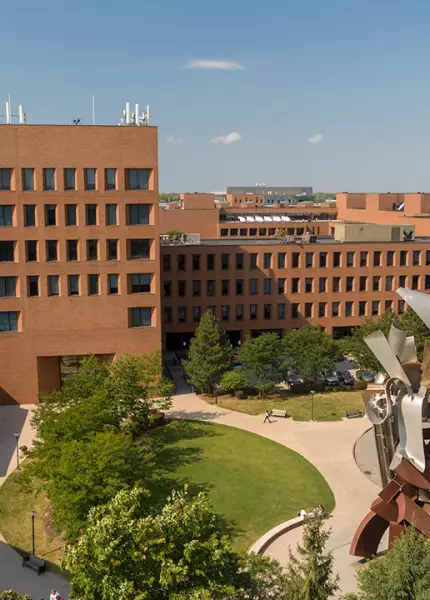


- Recent applied mathematics graduates employed at Google, Federal Reserve Bank of Cleveland, JP Morgan Chase, and Northrop Grumman Corporation.
- Join the PiRIT, a student club that fosters a community of students and faculty in mathematics and statistics who share the goal of enriching student understanding of the broad range of mathematics beyond the classroom.
Applied mathematicians develop models for perfecting global positioning systems, analyzing cost-effectiveness in manufacturing processes, or improving digital encryption software. The applied mathematics major focuses on the study and solution of problems that can be mathematically analyzed across industrial fields and research disciplines.
The applied mathematics major focuses on the study and solution of problems that can be mathematically analyzed. Industry, academia, and government all have a great need for individuals with this type of education. You will gain the knowledge and skills to collaborate on complex problems with scientists, engineers, computer specialists, or other analysts. Some application areas include applied statistics; biology; business; economics; chemistry; electrical, industrial, or mechanical engineering; operations research; and imaging science.
Graduates typically are employed in scientific, engineering, business, or government environments, applying their mathematics background to the analysis and solution of real-world problems.
Course of Study
You can choose courses from more than twenty application areas that provide them with the knowledge and skills to collaborate on complex problems with scientists, engineers, computer specialists, or other analysts. Some of those areas include applied statistics; biology; business; economics; chemistry; electrical, industrial, or mechanical engineering; operations research; or imaging science.
Real-World Experiences
You'll collaborate with a faculty researcher on a variety of projects in both applied and theoretical mathematics providing you with valuable exposure to real-world problems faced by America's top companies and research organizations. As a result, RIT undergraduates in mathematics are highly sought as co-op employees.
You'll also have the opportunity to work with researchers in the School of Mathematical Sciences studying interesting problems in areas such as computational photonics, mathematical biology, microelectromechanical systems, and network analysis.
Nature of Work
Mathematicians use theory, computational techniques, algorithms, and the latest computer technology to solve economic, scientific, engineering, physics, and business problems. The work of mathematicians falls into two broad classes – theoretical (pure) mathematics and applied mathematics. These classes, however, often overlap. Applied mathematicians start with a practical problem, envision its separate elements, and then reduce the elements to mathematical variables. They often use computers to analyze relationships among the variables, and they solve complex problems by developing models with alternative solutions.
Training Qualifications
Industry, academia, and government all have a great need for individuals with this type of education. Typically, graduates are employed in scientific, engineering, business, or government environments, applying their mathematics background to the analysis and solution of real-world problems.
In the federal government, entry-level job candidates usually must have a four-year degree with a major in mathematics or a four-year degree with the equivalent of a mathematics major. Outside the federal government, a graduate-level education is usually a minimum requirement; many seek advanced degrees in mathematics or a related discipline. However, those with bachelor's degrees who meet state certification requirements may become primary or secondary school mathematics teachers.
The majority of those with a master's degree in mathematics who work in private industry do so not as mathematicians but in related fields. For jobs in applied mathematics, training in the field in which mathematics will be used is very important. Mathematics is used extensively in physics, actuarial science, statistics, engineering, and operations research. Computer science, business and industrial management, economics, finance, chemistry, geology, life sciences, and behavioral sciences are likewise dependent on applied mathematics. Mathematicians also should have substantial knowledge of computer programming, because most complex mathematical computations and much mathematical modeling are done on a computer.
Master's Degrees and Doctorates
Graduate programs offered by the School of Mathematical Sciences introduce students to rigorous advanced applied mathematical and statistical methodology. Students realize the potential for that cutting-edge methodology as a general tool in the study of exciting problems in science, business, and industry. The school offers the following advanced degrees: an advanced certificate in applied statistics, master of science degrees in applied and computational mathematics and applied statistics, and a doctorate degree in mathematical modeling.
Combined Accelerated Bachelor's/Master's Degrees
Today's careers require advanced degrees grounded in real-world experience. RIT's Combined Accelerated Bachelor's/Master's Degrees enable you to earn both a bachelor's and a master's degree in as little as five years of study, all while gaining the valuable hands-on experience that comes from co-ops, internships, research, study abroad, and more.
+1 MBA: Students who enroll in a qualifying undergraduate degree have the opportunity to add an MBA to their bachelor's degree after their first year of study, depending on their program. Learn how the +1 MBA can accelerate your learning and position you for success.